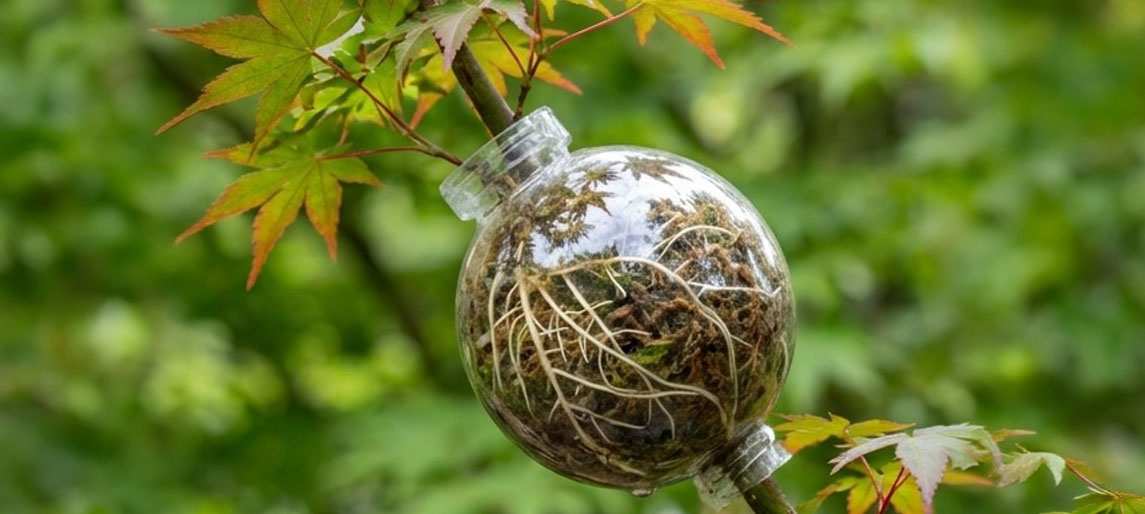
Air Layering Japanese Maple
A Guide to Propagation and Correcting Trunk Flaws
When we look at a Japanese maple, it is usually the foliage that enchants us. The colour, the leaf shape, the autumn fireworks. But the moment may come when we want to propagate it, or correct structural flaws. Perhaps the trunk proportions are not ideal, there are cylindrical sections, sections that are too long and uninteresting, perhaps we want to save a redundant branch, or simply propagate our maple. This is where air layering comes in — a highly reliable propagation technique that both hobby gardeners and bonsai enthusiasts can apply with success.
When is the best time to air layer a maple? Optimal timing
For kaede — the trident maple — and momiji — the palmate-leaved, or Japanese maple — the safest window is between mid-May and the end of June. At this time sap flow is strong, light is abundant, and the plant is actively working. The procedure can also be carried out at the end of winter, before bud break, in February or early March. The trident maple tolerates this better; the Japanese maple is more sensitive, but in experienced hands air layering can be started during this period as well.
The theoretical basis of air layering
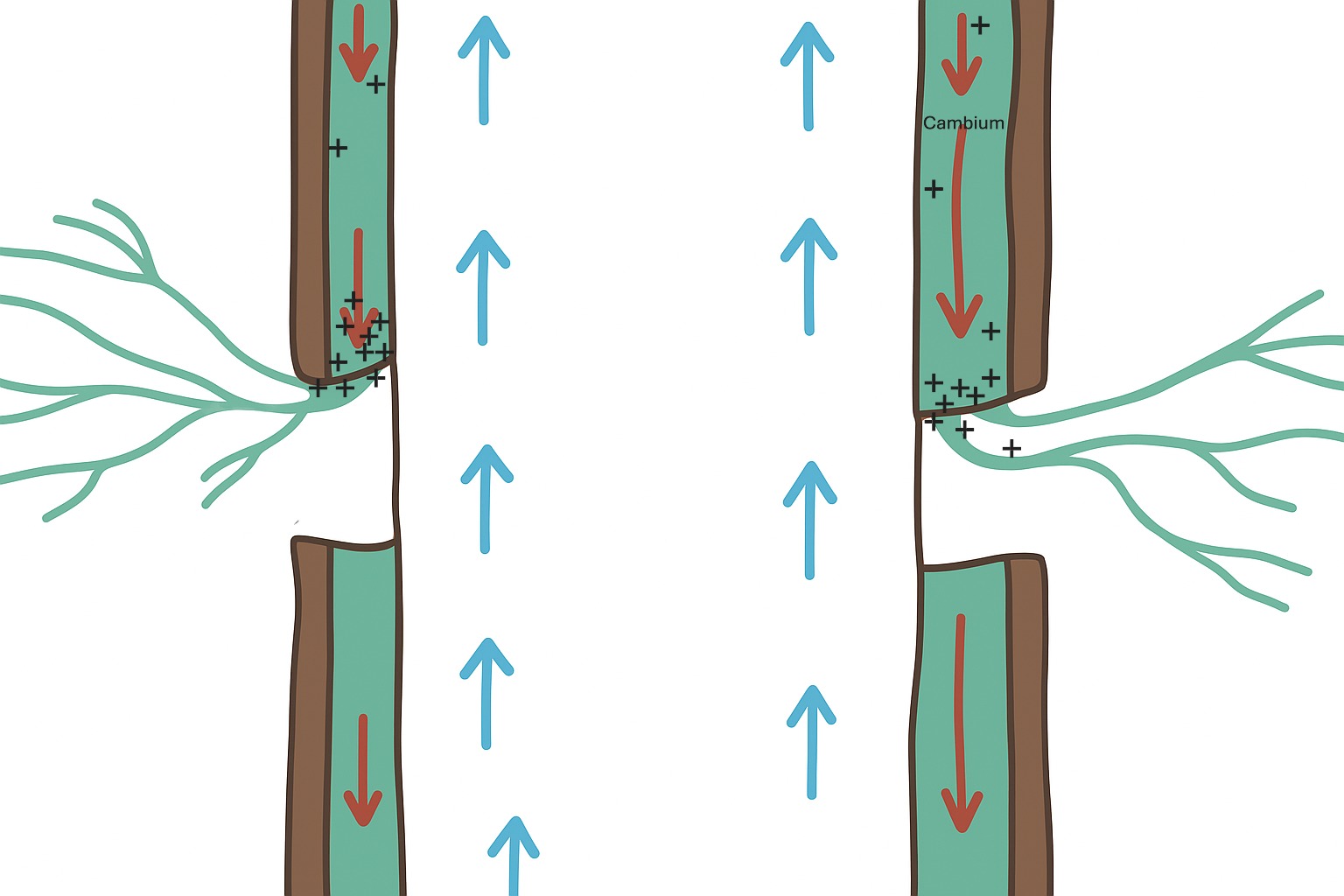
The essence of the process is simple, but requires precision. A ring of bark is removed from the trunk or branch. This interrupts the downward flow of sap, while water and nutrients flowing upward continue to reach the foliage. The upper part therefore does not die; on the contrary, it continues to live and work, while the section above the ring is forced to produce roots under the influence of accumulated nutrients and hormones. This is why air layering is considered a safe method — even in the event of failure, we do not lose the plant.
Steps of air layering
The procedure consists of four fundamental steps, which are common to all methods:
- At the chosen location, a ring of bark is removed from the trunk or branch. The width of the ring is generally 1.5–2 times the diameter of the trunk.
- The wound surface is moistened slightly, then rooting hormone is applied to the upper part, on the underside of the bark above the ring.
- The stripped area is wrapped tightly with sphagnum moss, secured firmly against the wood. The moss can be soaked beforehand — in water or in a root-stimulating solution.
- Maintaining continuous moisture is critical. If the medium dries out, callus will form instead of roots. Several methods can be chosen for wrapping.
Wrapping methods — which should we choose?
Film wrap method:
This is the most widespread home technique. The wound surrounded by moss is wrapped tightly with clear plastic film, and both ends are sealed. It is inexpensive, requires no special tools, and rooting progress is visible through the transparent film. However, it must be protected from direct sunlight (e.g. by wrapping with aluminium foil). Precise fastening is time-consuming, but it can be secured stably.
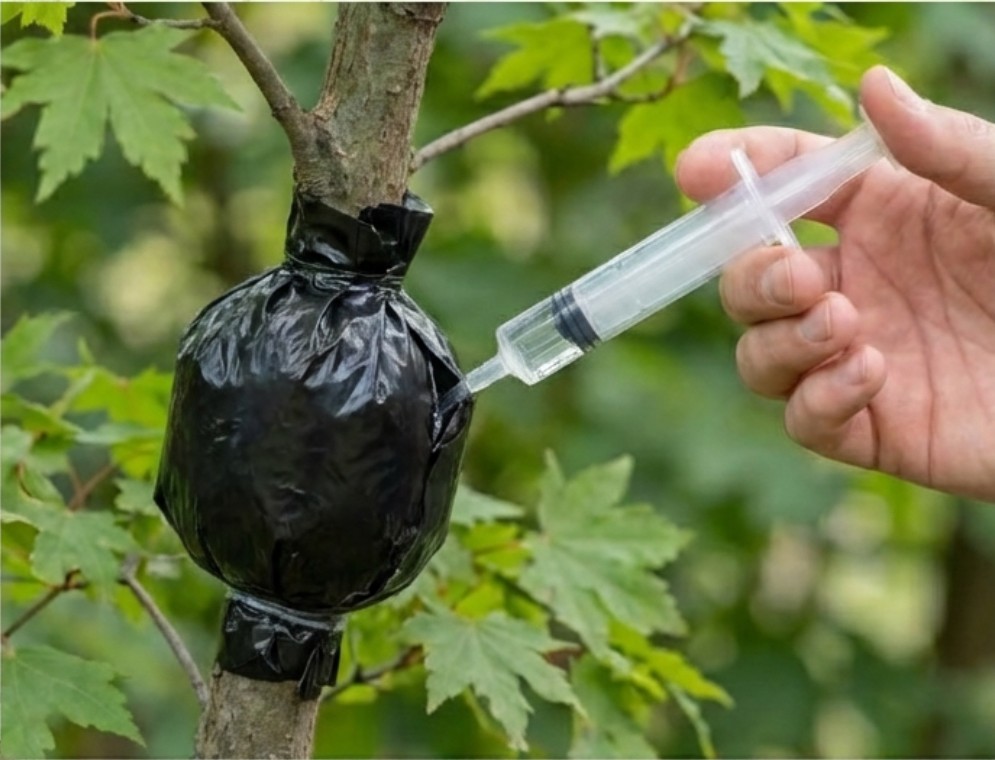
Bucket or container technique: In this method, a small plastic bucket or horticultural pot is modified. A hole is cut in the bottom and side of the bucket to accommodate the branch; it is placed around it and then filled with rooting medium. Compared to the film wrap method, it provides more rooting medium, is easier to monitor, but is heavier, and on thin branches a support (staking) may be needed due to the weight of the bucket.
Modern rooting enclosures (propagation spheres): Specialised rooting enclosures made from durable plastic, which can be snapped onto the branch with a click-lock closure. They are extremely stable, quick to apply and reusable multiple times. A professional solution — durable, reusable, and root development is easy to monitor. Available in black, white, and transparent versions, applicable according to requirements.
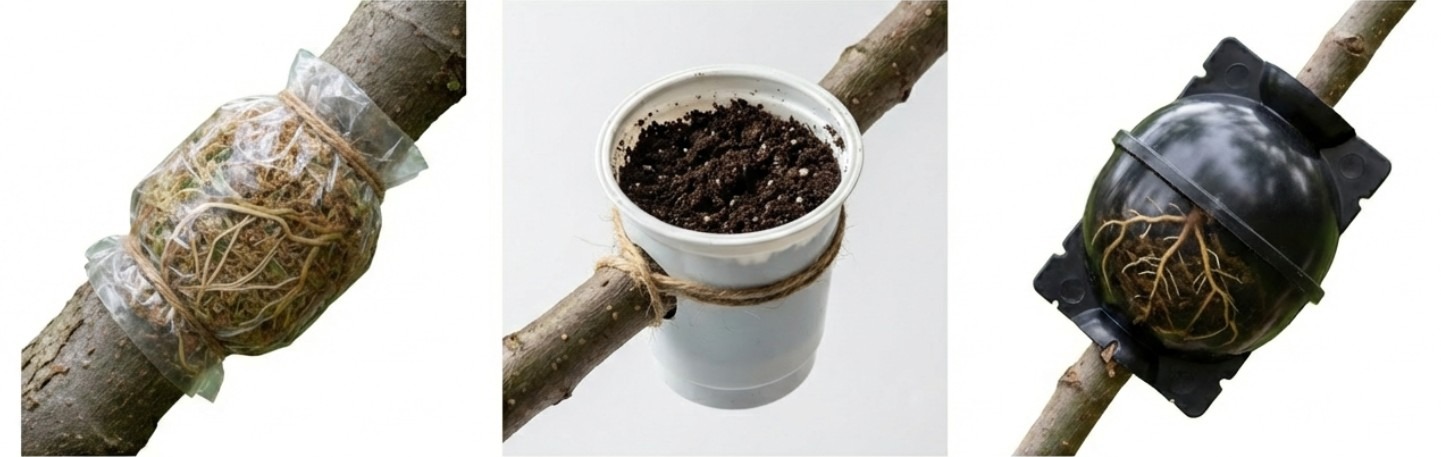
Alongside the classic film-wrap air layering, it is worth mentioning a lesser-known but highly effective approach. It is used primarily for bonsai material and is often referred to in the international bonsai community as the Ebihara method. The goal here is not merely to grow roots at a given point, but to deliberately shape the nebari.
The essence of the technique is surprisingly simple. Directly below the ring, a wooden board or plastic disc is secured to the trunk. This disc acts as a physical barrier when the newly forming roots begin to grow downward. Since they cannot grow vertically, they are forced to spread laterally, radially, across its surface.
The result is precisely that flat, broadly spreading root base we so often seek in bonsai. A well-developed, radial nebari immediately lends weight and maturity to the tree, especially in maples, where the lower portion of the trunk is of particular significance.
During air layering, the disc is fitted below the stripped bark and secured tightly to the trunk. The damp sphagnum moss and the chosen medium are then applied on top of it. The roots are thus guided along a predetermined path from the very beginning, and there is no need to later correct long, downward-growing roots.
This approach is not limited to air layering. It is also an established method for young seedlings or cuttings, where a wooden board is screwed to the base of the trunk to direct root formation laterally. If the new plant is intended for bonsai, this technique is well worth choosing.
Preventing callus formation in maples
There is a critical point with maples. They tend to quickly form callus and close over the wound. This is especially true of Acer buergerianum. If the plant bridges the ring, the downward sap flow resumes and all the work is lost. For this reason, thick aluminium wire is wound tightly around the upper edge of the stripped bark ring, in multiple turns if necessary. This mechanically prevents bridging from forming. If bridging occurs nonetheless, there is no alternative — a new ring must be made above the previous one.
The ideal rooting medium: a mix of akadama, pumice and kanuma
For the rooting medium, I recommend a well-proven blend: a combination of fine pumice, akadama and kanuma. A stable ratio is, for example, 25 percent finely sieved, washed pumice, 60 percent akadama and 15 percent kanuma. The pumice provides aeration, the akadama retains moisture, and the kanuma supplies the acidic environment that maples prefer.
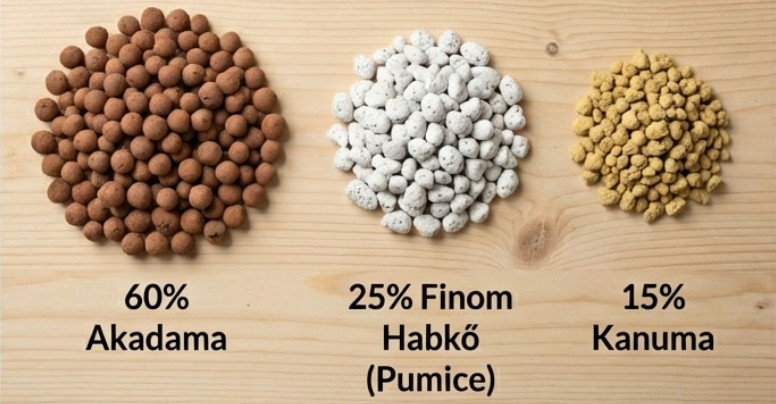
Of course, a mix of regular potting soil, seedling compost, coconut coir, moss and perlite can also be used if bonsai materials are not available at home — the plant will root just as well in this medium. Once the plant begins to root, it starts taking up water through these new roots. The medium can then dry out very quickly, which can lead to root death and desiccation. This is why it is important to maintain moisture (while still avoiding standing water).
How long does it take for a Japanese maple to root? Duration and factors
The time it takes to root depends on many things: the volume of foliage, the vitality of the plant, the weather, and the intensity of sap circulation. As a general rule, air layers started in spring can be separated within one growing season. On average, we can count on around three months. If we start work in early May, the ideal time for separation is likely to come around the end of August, after the peak summer heat. Faster rooting can occur with younger plants, but it is not worth counting on this.
Care after air layering — the critical period! The key is stability, shade and a good measure of patience!
The moment of separation is not the end of the story — it is the beginning of the most sensitive phase. The new plant must transition to independent uptake of water and nutrients, even though its root system still has limited capacity. At this point, every small detail matters: the medium, the anchoring, the placement and the watering.
Potting medium and container. The goal with the first potting is balance. The medium should retain moisture while remaining aerated. For deciduous species, including Acer palmatum, a mix of akadama, lava rock and pumice works well. A common ratio is 2:1:1, with akadama dominant due to its higher water retention. An important rule: the sphagnum moss used during air layering must not be removed. The fine hair roots developed within this medium are extremely fragile, and combing out the moss can result in losing a significant portion of the root system. (If bonsai materials are unavailable, a mix of acidic soil, mature compost and perlite can be used.)
- Stability and anchoring. This is one of the most important points. The newly formed roots are fine, fluffy in structure and extremely fragile. The plant must be firmly anchored to the pot with wire so that the trunk does not move at all. The pot can be moved carefully, but the plant must not move within the pot. If the tree shifts due to wind or being touched, the new roots can break, which may lead to the death of the plant.
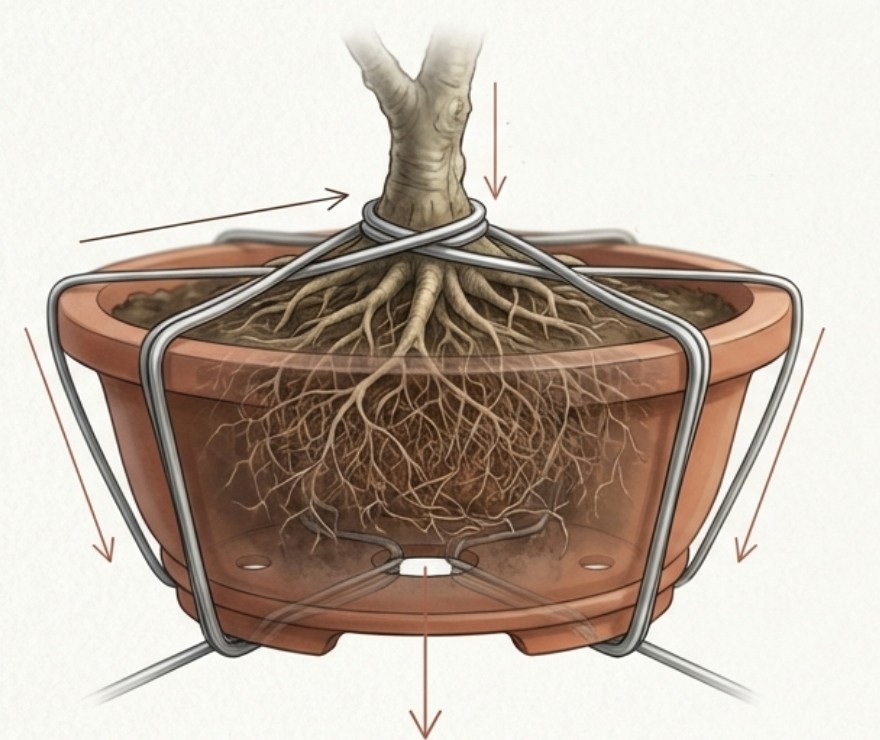
Proper anchoring is critically important Placement and environmental conditions. Separation is a shock for the plant. During the first 2–4 weeks, filtered light or partial shade is ideal. Direct sunlight would impose too great an evaporative load on a plant with still-limited root capacity. Wind protection is equally critical. A draught not only moves the tree but also significantly increases water loss. Occasional misting of the foliage can help reduce evaporative stress, especially in warmer weather.
Watering and nutrients. The soil should remain continuously and slightly moist, but never waterlogged. Overwatering creates an oxygen-deficient condition in the root zone, which can quickly lead to rot. Instead, think in terms of regular, controlled watering. No nutrients are given immediately after separation. We must wait until the plant visibly pushes new growth, or at least 4–6 weeks have passed. Only then can careful fertilisation begin.
- Balancing foliage and root system. Since the root system is still underdeveloped relative to the existing foliage, reducing the canopy is often justified. Cutting back the foliage by as much as 50–70 percent significantly reduces the water demand and aids survival in the first weeks. This is not an aesthetic intervention, but a physiological balancing act.
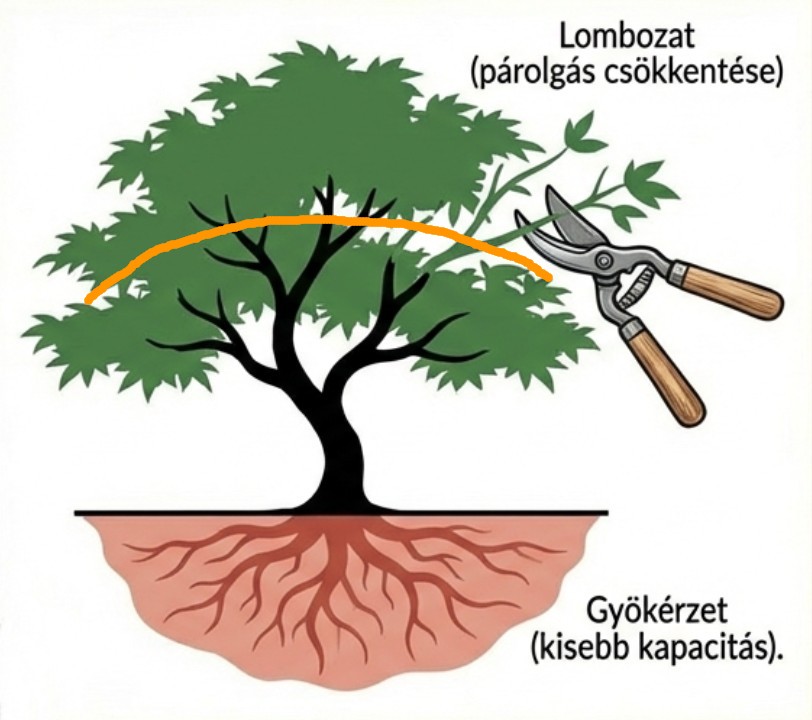
Cutting back the foliage - Winter protection. The first winter is particularly risky. The root system is not yet developed enough to withstand serious frost without difficulty. Ideally, overwinter in a frost-free or mildly cold location, such as a cold greenhouse or cellar. If left outside, the pot must be buried in the ground or thoroughly insulated. And it still must not move. Protection of the root system is the primary concern at this time.
To summarise: the freshly separated plant should not be disturbed, repotted, or have its roots adjusted for at least one full growing season. If it is given this calm, controlled period, we can continue working with a stable, developing specimen in the following year.
If it is not yet strong enough to separate
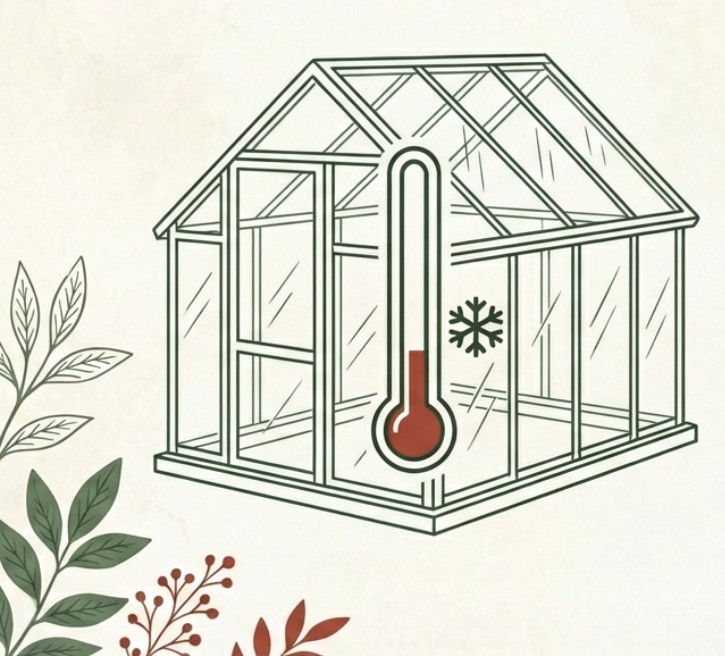
It is not advisable to separate just before winter if the root system is not yet strong enough. In that case, it is better to overwinter in a protected spot — even in a cold greenhouse — and separate in spring. If the tree is in the ground, the air-layered section must be carefully insulated and protected against frost.
Air layering for structural correction: three bonsai from one tree
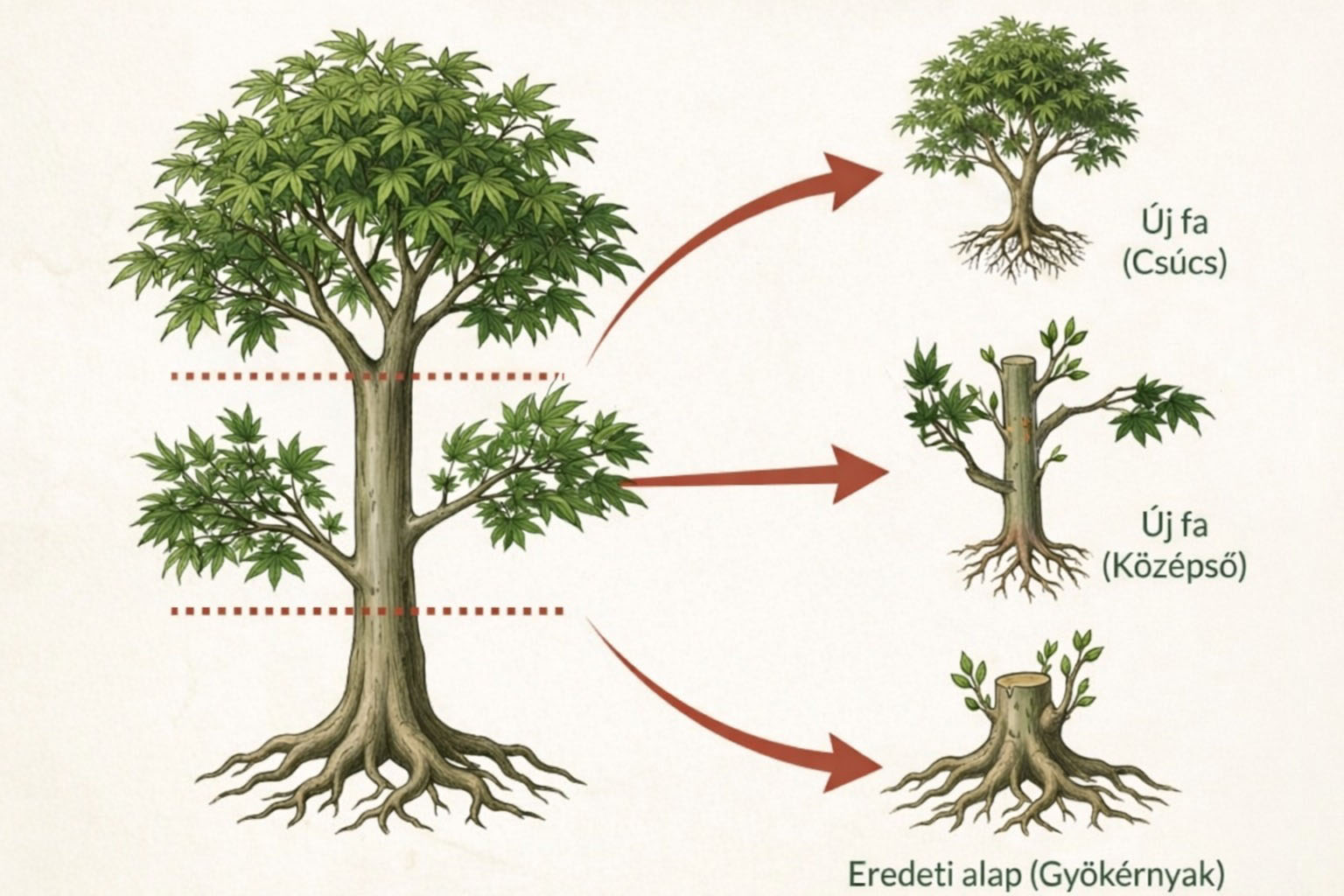
Air layering is not only a propagation method. It is also suitable for correcting serious structural flaws. A cylindrical, disproportionate section of trunk can be removed while yielding several usable plants in the process. From a single mediocre piece of raw material, as many as three promising trees can emerge — one from the apex, one from the middle section, and one from the original lower part.
Summary: practical advice for successful air layering
As a hobby gardener, there is no need to overcomplicate things. Observe the tree, choose your timing wisely, work cleanly and precisely, and keep the medium moist. The maple is a rewarding species. If it is strong and healthy, it will almost always respond to the technique. Aftercare is an extremely critical period — we must take care of the tree’s protection to ensure success. And air layering not only gives us a new plant, but an opportunity to consciously shape the tree we are working with.