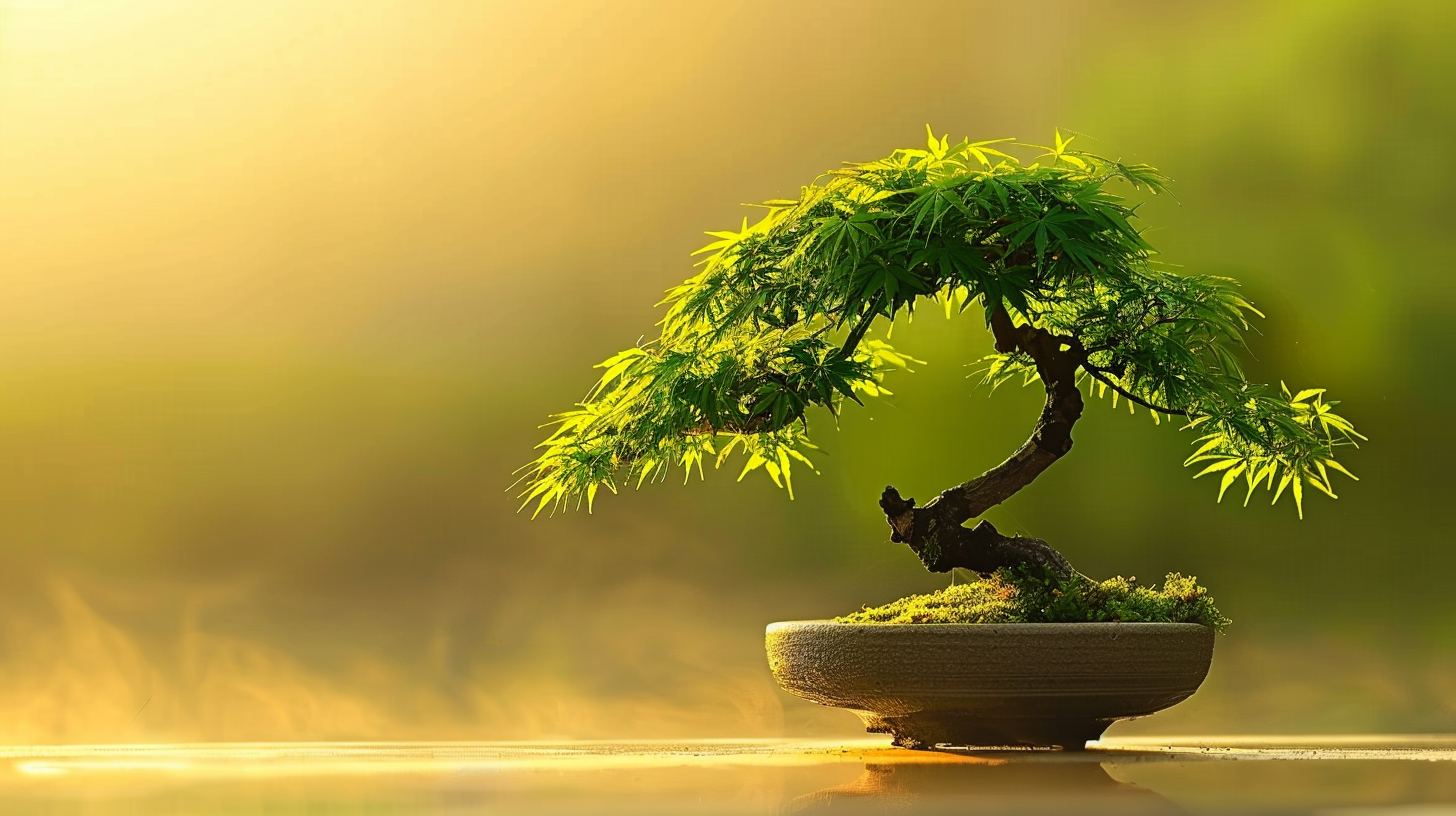
Bonsai Energy Management
Beyond art, in the language of physics and biology
Many people view bonsai as purely an aesthetic art form, where shaping is based on intuition and tradition. However, there exists a systematic, logical approach that regards the tree through an energy-based framework. The essence of bonsai can be distilled into a single principle: the production of energy and its conscious redistribution in service of our aesthetic goals.
1. The engine: Photosynthesis is the only energy source
The foundation of this framework is one of physics’ most fundamental laws: the conservation of energy. For a tree, the only mechanism by which it can produce energy is photosynthesis. Sunlight reaching the leaves is converted into chemical energy (in the form of sugars and starch), which is stored in the tree’s tissues. From this follows a critical insight: leaves are, in fact, the tree’s “solar panels.” The more leaves a tree has, and the healthier they are, the more energy it can produce for growth, wound healing, and root development.
2. Nutrients are not energy
Beginning bonsai collectors often make the mistake of identifying fertilisation as the “source of energy.” However, nutrients do not contain energy in themselves. Nitrogen, phosphorus, and potassium are merely building blocks that support the efficiency of photosynthesis and the formation of new foliage.
Important rule: A weak tree with little foliage cannot be “cured” with fertiliser. If there is insufficient photosynthetic surface area (leaves), the tree cannot utilise the nutrients — and worse, excessive salt concentration can damage the roots.
3. Climate and strategy: Why doesn’t the same approach work everywhere?
Light intensity varies dramatically across different regions. For example, the United Kingdom or Northern Europe receives approximately forty percent less sunlight than Spain or Japan.
- Southern regions: Thanks to abundant light, masters can apply aggressive techniques (heavy pruning, full defoliation), because the tree replenishes its reserves quickly.
- Northern regions: Greater caution is required here. The 40% energy deficit must be compensated with denser foliage, longer extended shoots, and fewer interventions.
4. The annual energy cycle: Managing the units
Imagine the tree’s energy as a bank account that fluctuates continuously throughout the year:
- Spring: The tree starts from its reserves (e.g. 100 units), and spends a significant amount of energy during bud break (the level may drop to as low as 70 units), as the new leaves are not yet producing — only consuming.
- Summer and Autumn: This is the accumulation period, when fully developed leaves recharge the “account.”
- Management: For trees under development, the goal is maximum energy gain (e.g. 200 units) in order to promote thickening. In contrast, for refined, finished bonsai, the goal is to maintain balance (e.g. 110 units) to avoid coarse, aesthetically disruptive shoots.
5. Energy redistribution and apical dominance
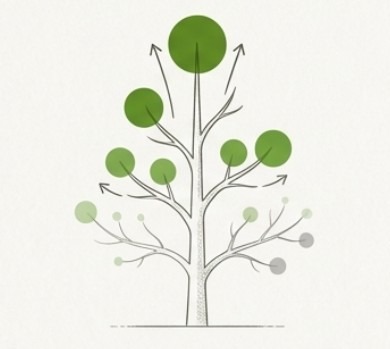
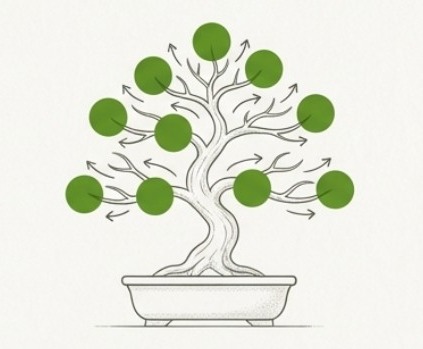
Trees are naturally programmed for efficiency: they send energy where the most light reaches them (this is the apex, or apical dominance). However, this conflicts with bonsai aesthetics, where we want strong lower branches. Bonsai techniques (pinching, pruning, wiring) are essentially the manipulation of hormones called auxin, which forces the tree to redirect energy not to the apex, but to the weaker, lower areas.
6. Golden rules in practice
- Only one major intervention per season: Every major operation (repotting or significant styling) burns through a great deal of energy. If both are performed simultaneously, it can lead to the tree’s death.
- Read the tree: The size of the buds, the flexibility of the branches, or — in pines — the retention of second-year needles all reveal the current energy reserves.
- Sequencing: The root system must be put in order first (water-oxygen balance), so it is capable of producing foliage, which in turn generates energy.
An analogy for understanding:
Think of the tree as a solar-powered house with a battery. The leaves are the solar panels that charge the battery (the tree’s tissues). In winter and early spring, the house runs on battery power. If too many “electrical appliances” (new shoots, wounds) are switched on at once before the sun comes out, the battery drains and the system collapses. The bonsai master’s task, therefore, is to regulate how much energy the panels produce, and which room has its light switched on.
Energy management, systematised
| Development stage or style | Primary goal | Energy level change by year’s end | Applied techniques | Nutrient supply strategy | Light requirements and foliage management | Physiological effect |
|---|---|---|---|---|---|---|
| Under development | Maximum energy gain, wound healing, trunk and branch thickening, establishing the primary branch structure. | Significant increase (e.g. from 100 to 200 units). | Allowing unrestricted growth, retaining every possible leaf, minimising pruning. | Intensive and generous nutrient supply to support growth. | Maximum sun exposure and maximising the photosynthetic surface area (foliage). | High auxin levels in shoot tips, stimulating the development of vascular tissue and rapid cell division for thickening. |
| Under refinement (Refined) | Controlled growth, maintaining fine ramification, preventing excessive vigour. | Minimal surplus (e.g. from 100 to 105–110 units). | Partial defoliation, or — in pines — needle thinning, candle pinching, strategic pruning. | Moderate or restricted nutrient intake to avoid coarse growth. | Reducing the foliage surface during the season to limit energy production. | Deliberate reduction of apical dominance and auxin concentration for a more even and refined distribution of energy. |
| Literati (more common in pines) | Maintaining the aesthetic of struggle and sparse foliage, keeping the tree in a state of near-starvation. | Barely changes (e.g. from 100 to 105 units). | Minimal pot size, restricted watering, leaving only a minimum amount of foliage. | Practically zero fertilisation. | Maintaining the smallest photosynthetic surface area necessary for survival. | Slowed metabolism and minimal reserve accumulation, which preserves the lean character of the trunk and branches. |
| Collected tree regeneration | Restoring viability, activating dormant buds, developing new root growth. | Slow stabilisation following an initial drastic decline. (2–3 years) | Protection from wind, reducing transpiration, delaying bud selection. | Slow-release nutrients, but only after the proper root-oxygen balance has been established. | Retaining foliage to maximise photosynthesis in support of root development. | Removal of inhibition caused by the loss of the apical auxin source, leading to the hormonal activation of dormant buds. |
Summary:
In this perspective, the art of bonsai is the production and redistribution of energy required to achieve an aesthetically perfect form. Those who internalise this logical, biologically grounded approach will find themselves with fewer lost trees and healthier, more rapidly developing specimens.
Bonsai is nothing other than the conscious and wise redistribution of the life force drawn from sunlight, in service of creating aesthetic balance. In this process, the tree’s natural drive to grow and the master’s guiding intention meet, so that from finite energy, infinite harmony may be born.
The core perspective detailed in this article was inspired by the theory of bonsai master Peter Warren, “The Bonsai Energy Management.” This article is not a literal translation, but rather a personal interpretation of the principles described.