The Most Common Mistakes That Are Silently Ruining Your Bonsai Tree
Bonsai Tips for Beginners
📅•🏷️Care•⏱️8 min
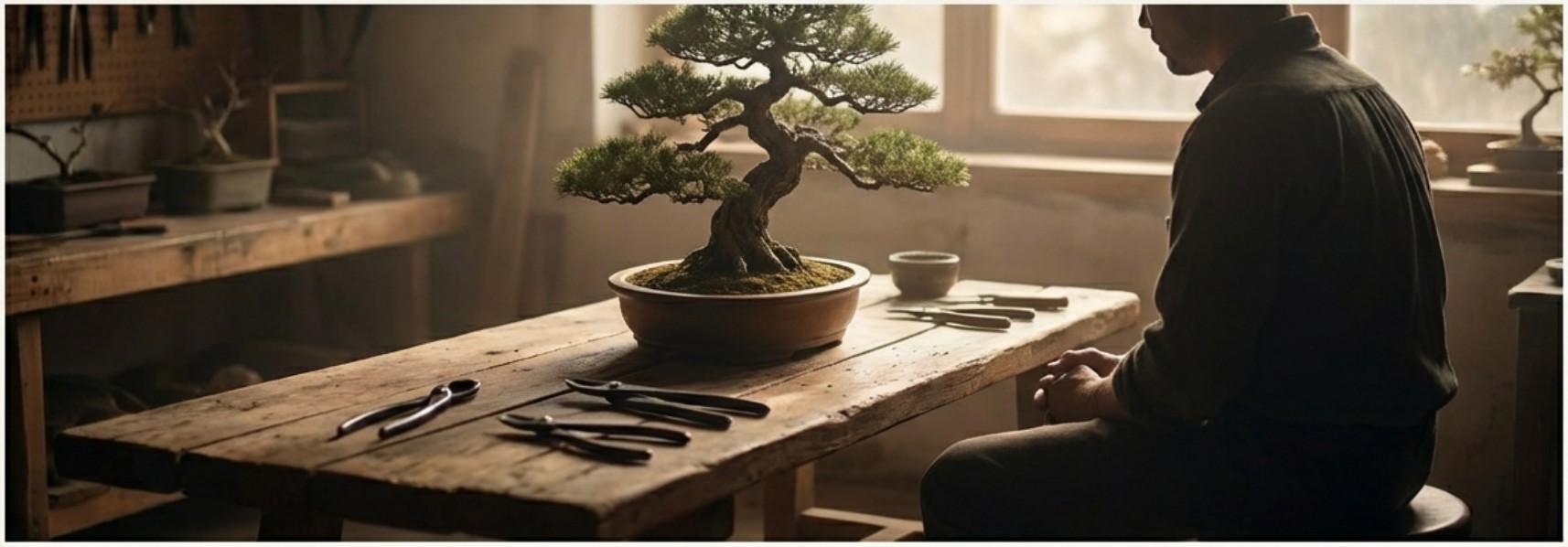
Bonsai care is the meeting point of long-term horticulture and an art form, where patience is at least as important a tool as scissors or wire. Most beginners don’t make mistakes because they don’t care about their tree — quite the opposite: they intervene too quickly, too much, and often in the wrong direction.
This article is for those who want to avoid the typical pitfalls that can set back — or even seal the fate of — a bonsai’s future by years.
The Cost of a Poor Starting Point
Many bonsai stories go wrong at the very first step. Most people choose a plant based purely on aesthetics — the beauty of its leaves — without considering its needs or natural characteristics. A common mistake, for example, is keeping outdoor, temperate-climate species indoors. Maples, junipers, and pines are not “houseplants”; they are trees that need natural seasonal change and a winter dormancy period. No living room can substitute for that.
Equally treacherous is the term “indoor bonsai.” While it sounds appealing, it’s usually just marketing. Even tropical species require plenty of (ideally natural) light and high humidity, which the average home rarely provides.
On the other hand, when looking for bonsai material at a nursery, choose something whose trunk already carries some movement (a curve, an S-shape, etc.). While a straight trunk can be bent in the early stages, the older the tree, the harder that becomes. So don’t waste years “fixing” poor material. Avoid reverse taper and dull, straight trunks. Better to spend time finding the right tree than to struggle for years forcing a weak plant. (Every bend involves some “damage” that can take the tree a long time to heal.) To understand why the concept of “movement” in a trunk matters, you can read about bonsai styles here.
Choosing good raw material can save us years of work
Poor Watering Technique Can Also Be Harmful
One of the most common causes of bonsai death is not pests or disease, but bad watering habits. Watering on a calendar schedule is an almost guaranteed path to failure. The soil in a shallow pot can dry out within hours, yet it can just as easily become waterlogged if the medium doesn’t drain well.
Overwatering is particularly dangerous because its effects are not immediately visible. The roots become oxygen-deprived, rot sets in, and the foliage only starts to yellow much later. By the time we notice the problem, it is often already too late. This is why bonsai soil composition is critically important.
Soil: Invisible but Decisive
The combination of regular potting compost and a bonsai pot is one of the worst pairings possible. These media compact over time, trap water, and exclude air from the roots. For a bonsai, soil is not merely a support medium — it is an active system that must simultaneously provide drainage and oxygen supply.
A granular, gritty medium — such as a mix of akadama, pumice, and lava rock — creates precisely this balance. It is no coincidence that this is one of the cornerstones of professional bonsai cultivation.
Waterlogged conventional potting soil versus a granular, active medium for the correct water–oxygen balance
Without Light, There Is No Life
Light deprivation is a subtle enemy. It doesn’t cause destruction overnight — it weakens the tree slowly. Keeping a tree indoors, even beside a window, already means a significant loss of light. This is why tropical bonsai kept indoors must be placed directly at the window without exception. If this is neglected, the plant responds with elongated shoots, thinning foliage, and ever-declining vitality — and will slowly perish.
A bonsai is not a decorative object. It is a living tree that needs energy to survive, and the necessary bonsai interventions — pruning, wiring, and repotting — come with an increased energy demand of their own. This is why it is especially important for a bonsai to receive adequate light.
Nutrients: Necessary, but Dangerous
Due to the limited soil volume, nutrient supplementation is essential — yet it is easy to overdo it. Too much fertilizer can literally burn the roots, especially when applied to dry soil. Poor timing is also a frequent mistake: during winter dormancy or immediately after repotting, the tree is unable to process the extra nutrients, and beyond causing harm, the nutrients simply go to waste.
Pruning, Wiring, and Fear
Many people are afraid to prune. They worry that one wrong cut will cause irreversible damage. In reality, most deciduous trees are surprisingly resilient, and a sound pruning strategy often breathes new life into the tree. Pruning stimulates dormant buds and helps develop a more compact, characterful structure. You can read more about bonsai pruning in this post.
With wiring, however, excess is the greatest enemy. Wire applied too tightly or left on too long can leave deep scars that may remain visible for decades.
Have a vision that guides the way we shape the tree
The Trap of “Instant Bonsai” Thinking
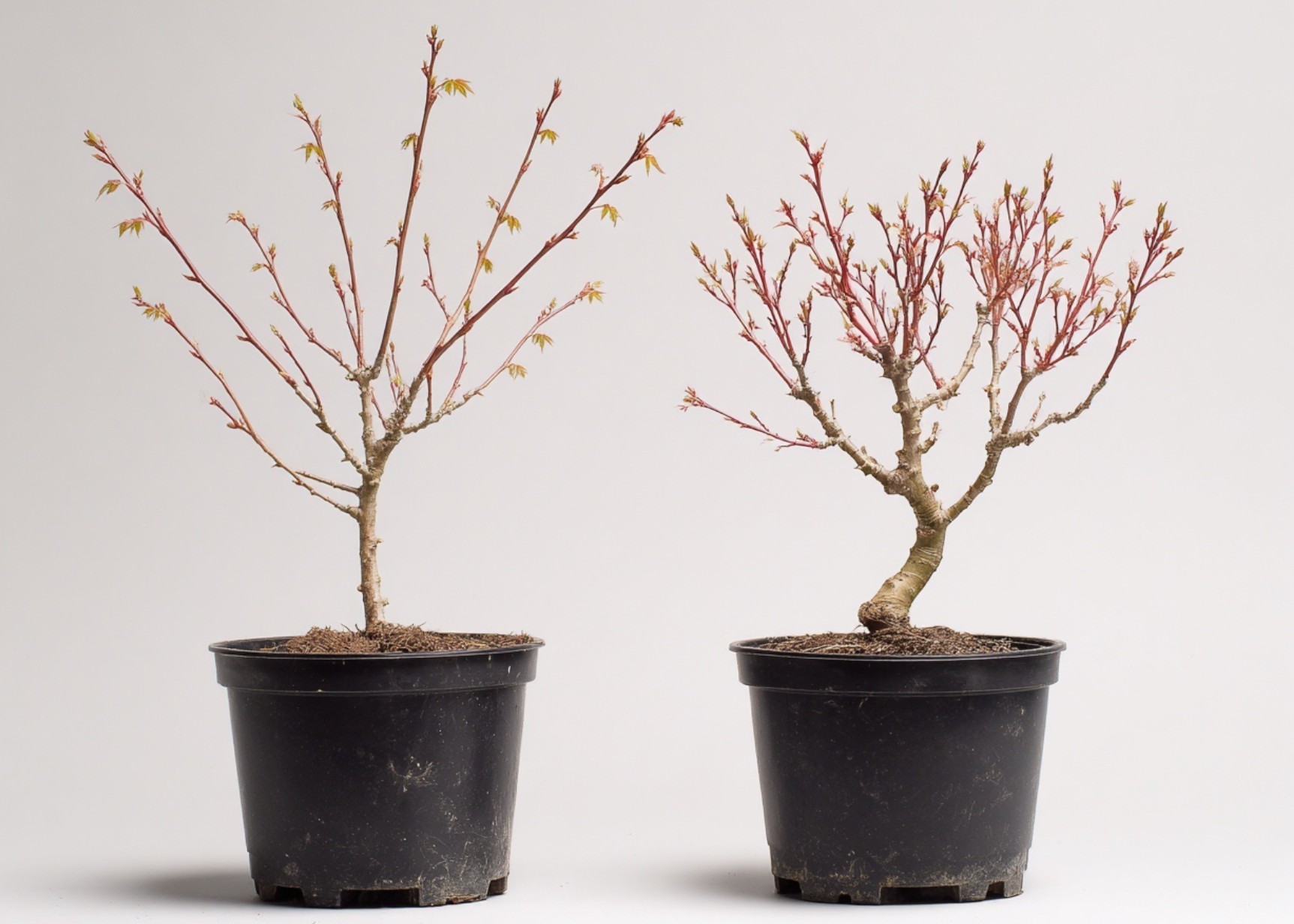
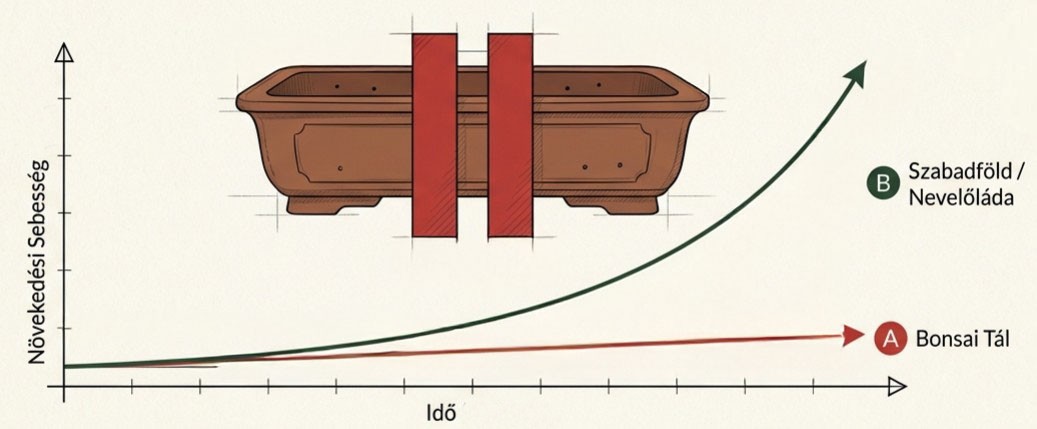
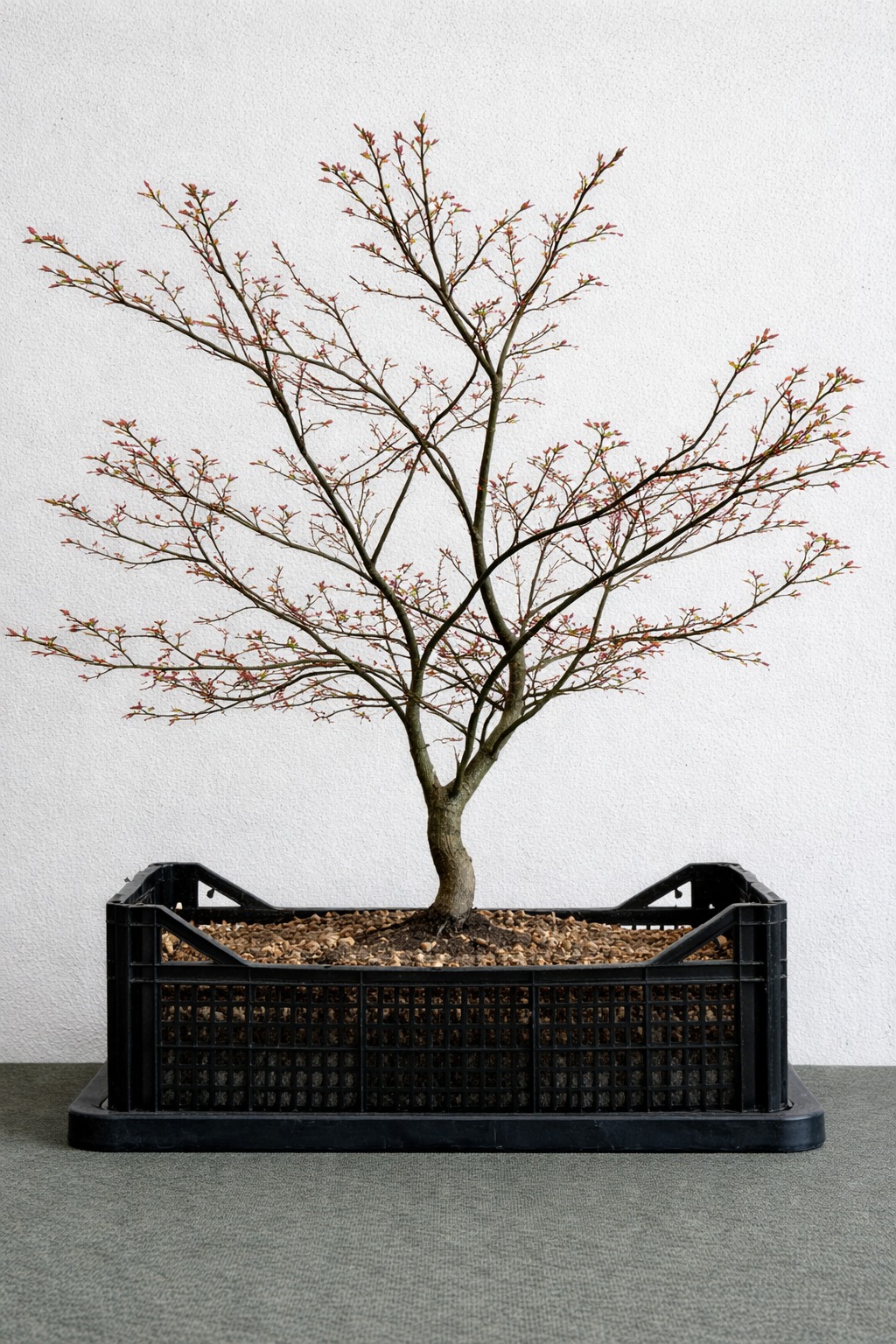
One of the biggest mistakes beginners make is placing the tree into a final display pot too early. For trees with well-developed, finely ramified structures, the small pot is precisely a limiting factor. Once a tree is placed in a bonsai pot, its development slows dramatically. Thickening the trunk, developing the nebari, and building the fundamental structure are all far more effective in a large growing container or even in the ground. What online shops don’t tell you: when you order a tree the thickness of a finger in a bonsai pot, it is indeed a bonsai — but for it to become a mature, truly high-quality creation, many more decades of work lie ahead. The reality is the exact opposite of what popular belief suggests. Once a tree is placed in a bonsai pot, the goal is no longer vigorous growth but rather its restraint: slowing growth, refining the branch structure, and perfecting proportions.
Growth comparison: in-ground versus bonsai pot
A Japanese maple in a growing box
Pre-bonsai phase
The reality behind the scenes is quite different from what we see at a bonsai exhibition. A developing tree is rarely impressive: branches are often intentionally allowed to grow long, to ramify freely, and to thicken. Building the trunk requires so-called sacrifice branches, which serve not beauty but rather the collection of more energy and the shaping of proportions. This phase can look chaotic — even "ruined" — through a beginner's eyes. The clean, refined forms seen at exhibitions represent a later stage: a tree on which the foundational work was completed years earlier. And while we tend to regard them as finished works of art, the truth is that a bonsai is never truly finished — it is simply in another state of balance.
To read more about the development phases a quality bonsai goes through, click here.
The Importance of Timing
The timing of repotting and major interventions is not flexible. For most species, the window is in early spring, before budbreak — or at the very least, after the last frosts have passed. Repotting in summer or winter can induce shock from which the tree may not recover.
The same applies to seasonality. Outdoor bonsai in winter are not protected by a heated room — they need a cool, even frosty environment. Root protection is important, but cold itself is not the enemy; on the contrary, it is a necessary biological condition for deciduous trees.
The True Lesson of Bonsai
The root of most mistakes is not technical but psychological. Rushing, excessive intervention, inattentiveness, impatience. Bonsai teaches you to observe first, then act. Sometimes the best decision is to do nothing — simply let the tree live its life. The secret of successful bonsai cultivation is learning to work in harmony with the tree’s own rhythm.
Environment - Grow in the ground or in a large container for a thick trunk; only move to a bonsai pot later (10+ years).
Soil - Use a granular, inorganic medium in the bonsai pot for maximum oxygen supply; supplement nutrients at the right time and in the right amount.
Energy - Cutting back the leader ‘reprograms’ the tree: energy flows to the lower branches and inner buds. This mechanism creates back-budding and, over time, a dense ramification.
Mindset - Bonsai is not about quick results. There are no shortcuts. The effects of every intervention (pruning, wiring) take months or years to manifest. Respect the tree’s rhythm.
This post was inspired by the https://www.youtube.com/@TheBonsaiGarden channel. Highly recommended.
🌿
Support my work
If you find this content valuable, please consider supporting me. Ideas are free — time is not. Your contribution helps me keep writing.