The Phases of Bonsai Development
A guide to the phases of bonsai development and the art of patience
When we first see a beautiful, mature bonsai, it’s easy to assume it’s simply a miniaturized version of a lovely plant. The reality, however, is far more complex. Every exhibition-quality bonsai passes through a carefully planned developmental journey, in which each phase serves a distinct purpose — and none can be skipped without consequence.
Throughout the cultivation process, every stage has its own biological logic, aesthetic purpose, and time requirement. Anyone who tries to skip or rush these stages will lock in mistakes that are nearly impossible to correct years down the line.
Let’s look at how a Japanese maple bonsai is built from the ground up to exhibition quality.
Creating the Potential (First Phase)
The story of a Japanese maple bonsai begins with purchasing a nursery sapling or propagating your own tree. This period is not visually impressive — there’s no “bonsai experience” yet — but everything that determines future quality is decided here. Short internodes, refined leaf size, and proportional habit are not born through later refinement; they are established in these very first years. An oversized container, excessive nutrients, or uncontrolled growth will fix characteristics that can never be fully corrected later.
By keeping the young plant in a small pot, we force slow growth. This results in extremely short internodes (under 1 cm). Since most deciduous trees bud at nodes, densely spaced nodes provide an abundance of future pruning and ramification opportunities along the lower portion of the tree.
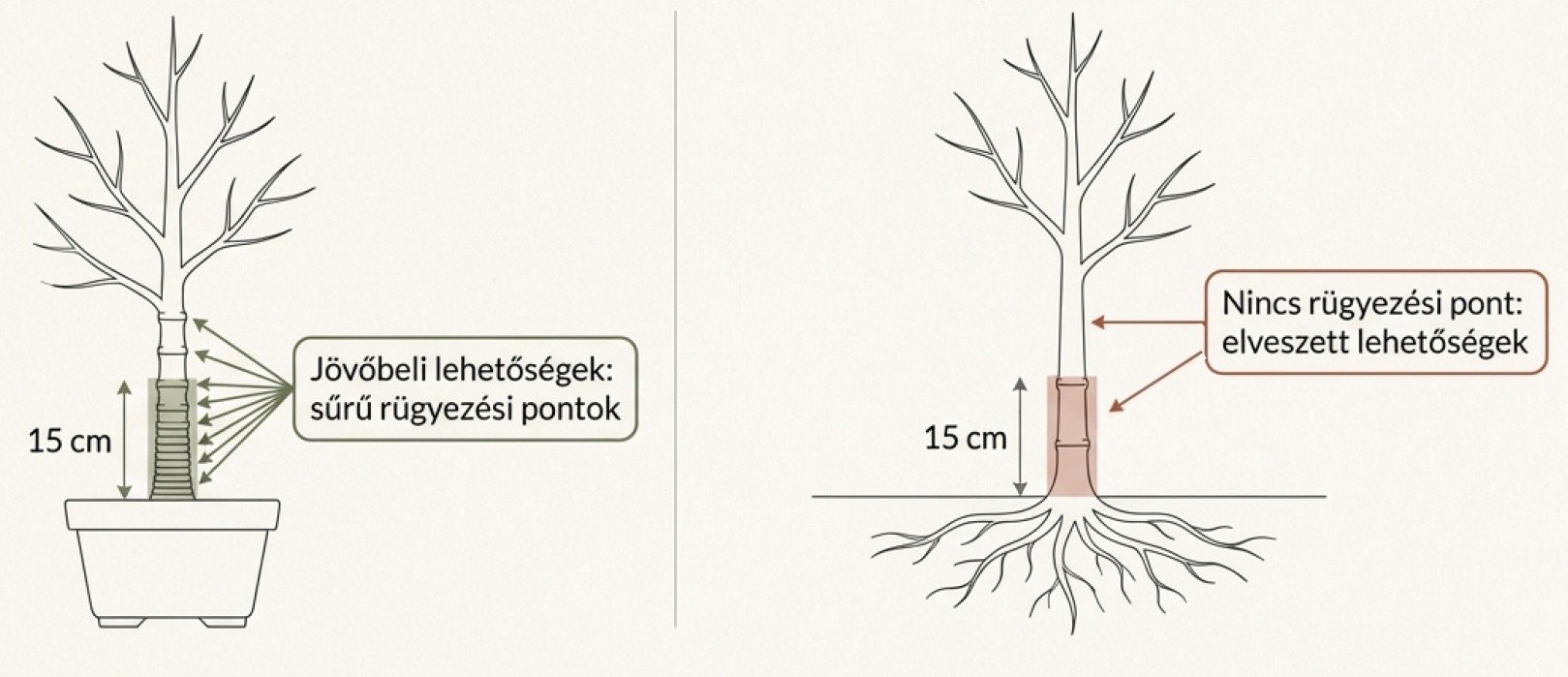
In this phase, the goal is therefore not rapid growth, but establishing the fundamental genetic and structural direction. Shaping the nebari, removing the taproot, and creating the first trunk movement are invisible yet decisive interventions that will define the tree’s future aesthetics.
Thickening and Establishing Proportion (Second Phase)
Once the tree has a stable foundation, it enters the growth phase. This is the stage where a bonsai looks more like a horticultural project than an artistic creation. Trunk thickening is slow — especially in maples — and for years it may feel as though nothing is happening. In reality, this is when the visual weight and proportion are being built, without which all the finer details that follow would become meaningless.
Choosing in-ground cultivation or a large growing container is always a compromise. The price of rapid thickening is less control, while container growing is slower but more predictable. The nebari (surface roots) here not only continue to develop but require constant attention. If neglected at this stage, only drastic, risky interventions can improve it later. To prevent roots from penetrating too deeply and to encourage them to spread laterally and radially, it is particularly useful to place a disc-shaped flat board beneath the trees. This is a root-training method that prevents downward root growth, encourages the formation of a shallow, flat root mass, and after a few years significantly eases the lifting of the tree. At this stage, root pruning is often a more important intervention than canopy shaping. Root training and root pruning should be carried out at the end of the dormant period, in early spring before bud break, when the tree is just awakening but sap flow has not yet begun.
The purpose of root training is not aesthetics but functionality: establishing a root structure that will later reliably nourish the tree within a limited soil volume and enable a proportional trunk–canopy–pot relationship. Without this, the tree is placed in a bonsai pot too early, where its development slows and its imbalance becomes fixed.
The development of freshly planted or transplanted, ground-grown trees generally follows a predictable pattern. The first year is usually slow, as the tree processes the shock of transplanting and adapts to its new environment. In the second year, the root system begins to develop in earnest; the tree “settles in” and makes increasingly confident use of the available space and resources. From the third year onward, and in the years that follow, truly visible growth begins — trunk thickening and vigorous overall development become apparent to the eye. When we compare this to container-grown trees over the same period, growth is often barely noticeable. It doesn’t stop entirely — it’s more as though the tree has been switched to slow motion.
During this period, there is the opportunity to periodically cut back upper growth (and perhaps air-layer certain branches, thereby creating new individuals as well). The trunk will still thicken significantly, while the roots spread laterally and radially. Moderate pruning helps lower branches gain strength and encourages better structure to develop — though caution is important. The goal remains vigorous growth, and excessive cutback would only hinder development.
Design and Structure (Third Phase)
When the trunk has reached the appropriate thickness, the true art of bonsai creation begins. This is the phase in which it is decided what tree the viewer will ultimately see. It’s not the small details that matter here, but the primary branch structure, the sense of space, and the direction of the tree. The quality of work done during the in-ground phase will now show its signs: poorly chosen branch positions, overly symmetrical structure, or poorly healing wounds can betray past mistakes for a long time.
This period often involves major cuts and lengthy healing processes. Wound treatment is not merely a technical matter but an aesthetic decision. A well-placed cut will eventually become invisible; a wound made in the wrong place will draw attention away from the entire tree for decades.
One must accept it: many branches that grew during the previous phase will be removed. They are coarse, thick, and unsuitable for bonsai. The new structure is built from fresh shoots emerging from the cut stumps. At this point the tree often looks “ugly,” with long, unruly branches.
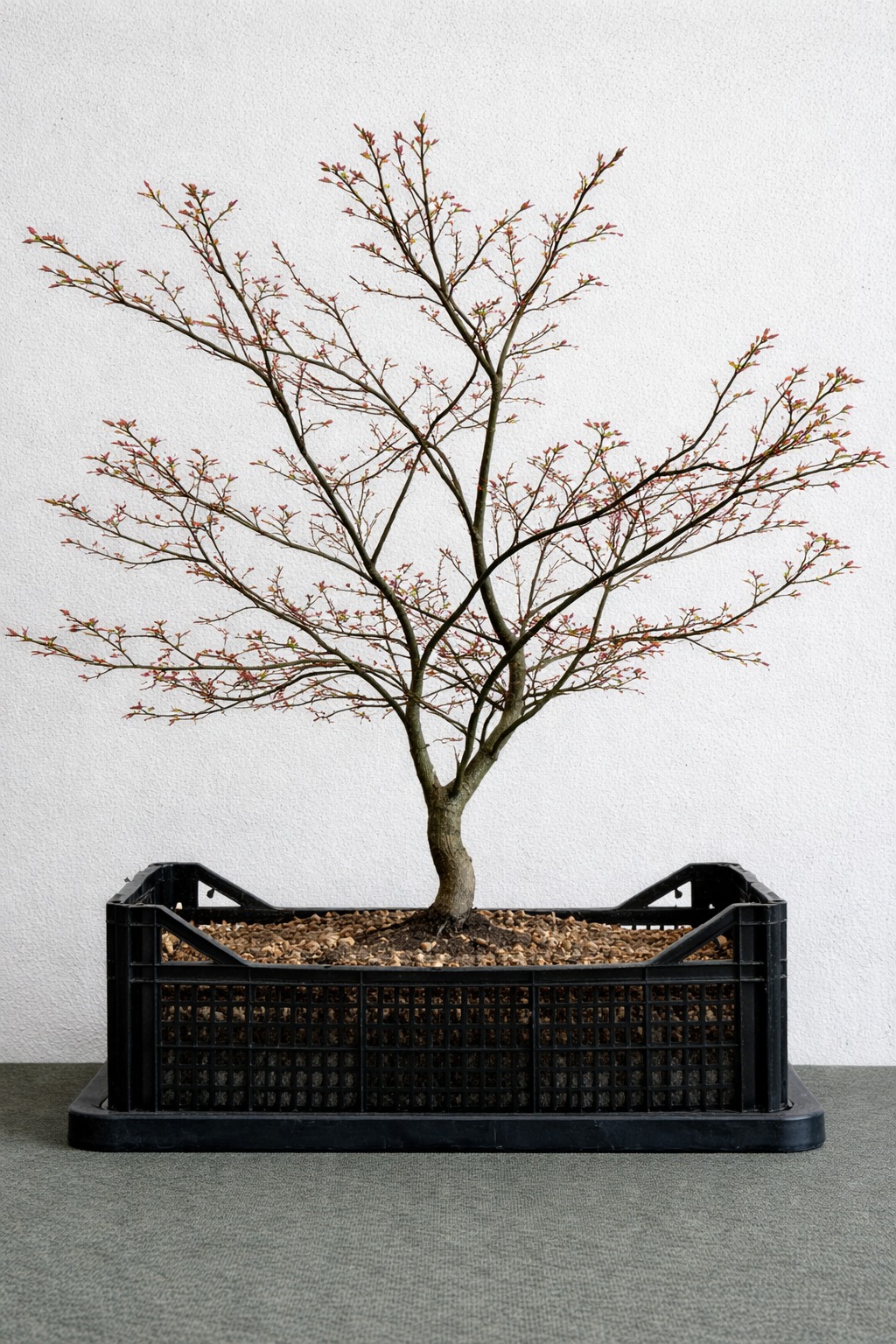
This is where the bonsai grower learns that not every branch needs to be kept — even if a great deal of time and energy has gone into them. Fewer, well-placed branches create the calm and naturalness that will become one of the Japanese maple’s greatest virtues.
A Shortcut?
Many people purchase a tree at this phase, thus bypassing the first two phases. But a common mistake is choosing poor material — weak roots, or a trunk that is flawed from a bonsai perspective, and which is nearly impossible to correct later. What should you look for when buying?
What does the nebari look like?
Is the surface root system well-organized and radial?

How much trunk work is needed?
Are there reverse tapers or unsightly scars?
Should major cuts be expected?
Can the existing branches be used, or will they need to be removed?
Refinement (Fourth Phase)
The refinement phase is no longer about dramatic interventions. The goal here — a dense yet airy canopy, the natural rhythm of fine ramification, and the complete disappearance of cut marks — all serve to allow the tree to live its own life in the pot.
During this period, the bonsai pot is not merely decorative but functional. The limited space slows growth and helps maintain the balance in which the tree is no longer “developing” but maturing. This is where the Japanese maple reveals its true beauty: subtly, showing a slightly different face season by season.
Refinement, in truth, never truly ends. Only the rhythm of intervention slows, and increasingly it is small corrections that take center stage. A well-built Japanese maple bonsai at this stage commands respect — one can sense the decades of work by its caretaker or caretakers within it.
Exhibition Bonsai Quality
At this stage, the tree no longer changes dramatically. The work consists of preserving and perfecting the existing form. The goal is a tree that speaks for itself. There are no visible cuts, earlier interventions are nearly imperceptible, and no wire is visible. The result is a tree that appears ancient, natural, and effortless — while in reality it carries the imprint of decades of conscious, disciplined work.
The Illusion of a “Finished Bonsai,” or Please Don’t Do This
It’s a common occurrence: someone buys a nursery-grown Japanese maple and, in a single move, places it into a shallow bonsai pot. From that moment on, the tree receives a label: “bonsai.” Story closed, phases skipped, proportions ignored. The form does not justify the pot, the trunk carries no age or weight, and the canopy is in harmony with neither the roots nor the container. Yet this is now considered the final destination.
The problem is not with the pot, but with the absence of time. The bonsai pot is not a magic tool — it is a consequence. It is brought out when the tree can already support, both visually and biologically, the restriction that the pot represents. If this happens too early, the tree does not become refined — it is merely “compressed.” The imbalance does not improve; it is simply preserved.
A bonsai is not a bonsai because it sits in a small pot — it is a bonsai because it is the result of a long developmental process. Placing nursery material into a bonsai pot is not a completion; most often it is a dead end. A state in which the tree can no longer develop — or would need at least 120 years to achieve what could be reached in 10 years through the proper phases.
This illusion is understandable: everyone wants quick results. But bonsai is not about that. It requires time, and if we invest the necessary time, it gives back something that cannot be purchased: authenticity.
Should I Buy a “Real” Bonsai?
When someone buys a “finished” bonsai, they are in reality stepping into the middle of a story. Behind the tree lie years, often decades, of decisions, mistakes, and corrections — all of them invisible. Without this background knowledge, you gain no advantage from the tree being beautiful and mature; in fact, the tree itself becomes vulnerable in the absence of knowledgeable hands.
Growing your own, by contrast, is a learning process. You grow old together with the tree — or trees. You come to understand what it means to restrain vigor, to direct energy, to know when to allow growth and when to restrict it. You learn to recognize the balance between canopy, trunk, roots, and pot — not in theory, but through experience.
This doesn’t mean you should never buy a finished bonsai. Quite the opposite. But it makes sense to do so only when you already know what you’re holding in your hands. When you don’t just look at the tree, but understand it. When you’re not afraid to touch it — and don’t touch it unnecessarily either.
Growing your own is therefore also preparation. A foundation without which even the most beautiful bonsai remains merely a fragile object. Together with it, we learn patience, we learn to think in temporal horizons and seasons, and we learn to accept that bonsai is not a quick Instagram post, but a long relationship.
Summary
The individual phases cannot be accelerated without consequence, and none of them can be skipped. What seems like carelessness at the beginning becomes an irreversible compromise later — or extends the transformation process by years. In return, however, if each period receives the time it deserves, the tree will not only be beautiful, but authentic.
And perhaps this is the most important lesson bonsai offers: it does not matter how quickly we arrive at the final form, but that along the way, we ourselves have been shaped by our tree.
One piece of good advice: don’t hesitate to grow several trees at once — if you make a serious mistake with one, you won’t have to wait another 10 years for the next tree to catch up :D. Good luck!