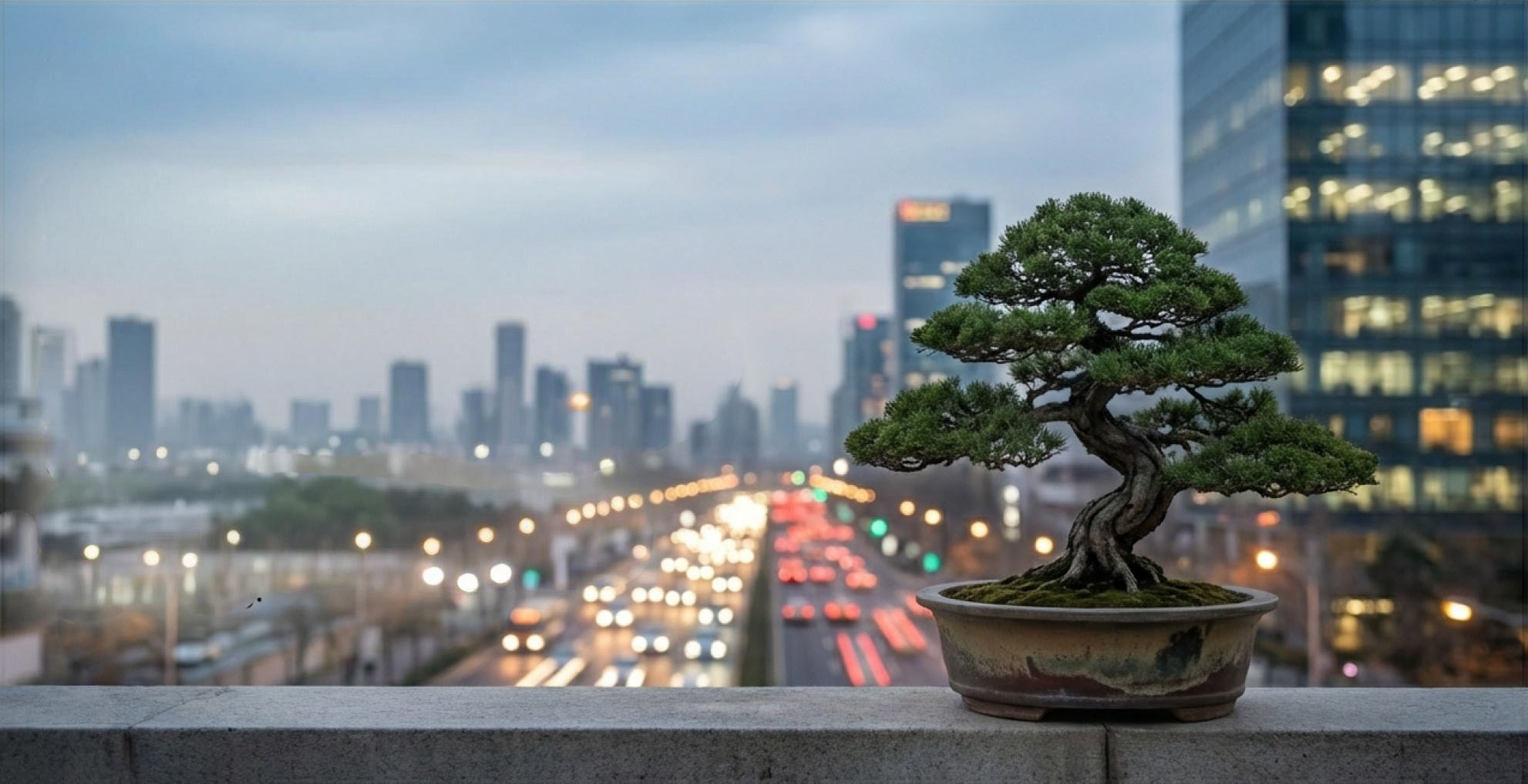
Bonsai: a Living Connection in the Digital World
Nature as a Mental Refuge
Mental Health, Attention, and Connection in an Overstimulated World
One of the greatest challenges facing modern people is not a lack of information, but quite the opposite: the constant noise. Notifications, deadlines, expectations, screens. In this environment, nature — and bonsai within it — has become more than just a hobby; it is a counterbalance. A slow, patience-demanding practice that calls for genuine presence.
Gardening is proven to reduce stress, improve mood, and have a calming effect on the nervous system. But bonsai goes one step further. We are not merely tending a plant — time itself becomes tangible. Sitting before a bonsai, the minutes lose their usual meaning: there is no hurry, no rushing, only presence. Attention slows down naturally, the movement of the hands grows more refined, and thoughts grow quiet. This kind of focus is very close to meditation. In these moments, we are not watching time pass, but experiencing its value — the way it shapes, forms, and matures over the years. It is difficult to comprehend that, under ideal conditions, a bonsai tree may outlive us. Our hours and years seem small beside the lifespan of such a tree. Yes, trees are simply like that. But bonsai is different in this regard too. While a tree planted in open ground is bound to a single place, a bonsai is in motion. It can pass from hand to hand, connect generations, display its beauty at exhibitions, and carry forward the time that someone once invested in it. This is what gives the time spent with bonsai such profound significance.
Digital Dependency and the Attention of Young People
For younger generations, the greatest challenge today is not acquiring information, but sustaining attention. The digital world is fast and built on instant gratification. Bonsai, by contrast, is frustratingly slow — and it is precisely this quality that makes it instructive. A young person who begins working with bonsai quickly discovers that there is no “instant success” here. The effect of a pruning cut may not be visible for months. The consequences of a poor decision can follow you for years. This experience quietly but firmly recalibrates one’s thinking: nothing happens immediately, and a mistake cannot be corrected with a single click.
Bonsai also offers a tangible connection to reality. It is not a virtual tree, not a simulation. It lives, responds, grows, and demands care. For many young people, this can be a first experience of taking real responsibility for something that is not digital, not reversible, and not “resettable.”
A Quiet Refuge for the Busy Middle-Aged
The middle stretch of life is often a period of overload. Work, family, expectations, the pressure to perform. In such times, bonsai is not one more task, but a rare space where you are not required to rush anywhere.
A bonsai does not hold you accountable or expect a report by tomorrow. The time spent with it is not “productive” in the conventional sense — and that is precisely why it is liberating. It is an activity in which we are not goal-oriented, but simply present.
Caring for bonsai helps us find our way back to the seasons, to rhythm, to natural limits. It reminds us that not all growth is dramatic, and not all progress is measurable in the short term. This perspective can be recognised in other areas of life as well. The mastery of a skill, for example, shares one of the most important qualities with financial investment and bonsai alike: time horizon. Those who are impatient with money — buying and selling aimlessly, rushing decisions — will inevitably lose in the long run. Bonsai teaches patience.
Old Age and Easing Loneliness
One of the greatest challenges of old age is the absence of connection. At this stage of life, bonsai is a faithful companion. It does not replace people, but it gives meaning and structure to daily life.
Caring for a tree demands regularity. Attention, observation, small decisions. This keeps the mind fresh and fosters emotional attachment. For many elderly people, bonsai is not just a plant but a story: the imprint of memories, years, and choices.
What is more, bonsai often sparks conversation. People share it, show it off, give and seek advice — in short, it connects people. It can be a common topic that bridges the gap between generations as well.
A Common Language Across Different Walks of Life
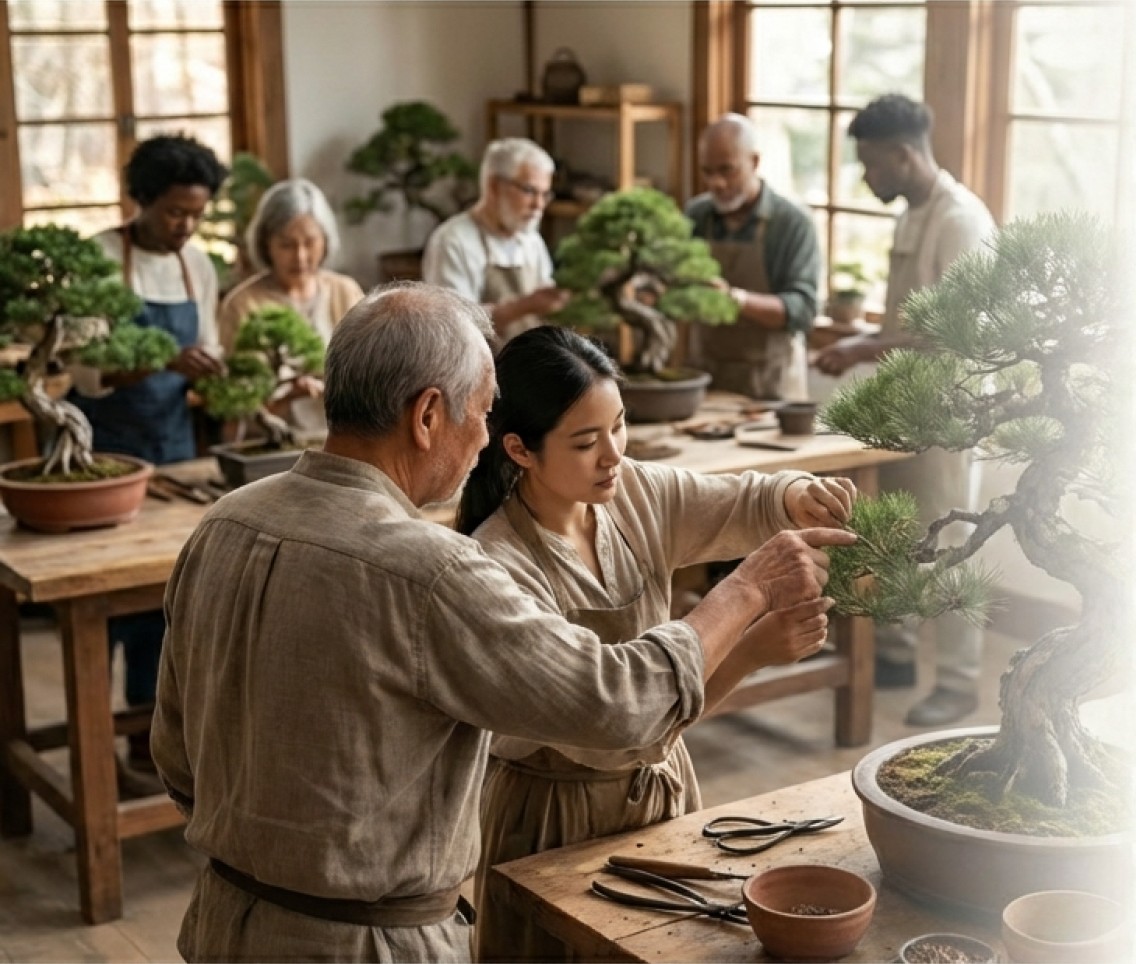
Perhaps one of the most beautiful qualities of bonsai is that it makes no distinction between social backgrounds. At a workshop, a young person and an elderly one may sit side by side, a beginner next to an experienced practitioner, someone from the city next to someone from the countryside. Here, everyone is a student.
During styling sessions and collaborative work, divides disappear. What matters is not where you come from, but what you see in the tree and how you relate to it. Bonsai culture thus creates community without any effort.
Physiological Effects During Bonsai Stimulation
| Parameter | Bonsai Effect | Consequence |
|---|---|---|
| Cortisol level | Up to 25% reduction | Lower stress levels |
| Parasympathetic tone | High activity | “Rest and digest” state |
| Heart rate (HRV) | Increasing variability | Better emotional regulation |
| Prefrontal cortex | Reduced activity | Mental relaxation |
Healing Through Trees? Therapeutic Applications
Bonsai therapy has proven particularly effective among groups living in isolation or having experienced trauma:
- Trauma processing: Studies conducted with young people have shown that shaping a tree supports emotional self-regulation; pruning can symbolise releasing past pain.
- Elderly well-being: In older adults, it slows cognitive decline, improves fine motor skills, and gives meaning to daily life.
- Rehabilitation: In patients with spinal cord injuries, viewing bonsai increases vitality and reduces levels of anger.
Summary: Community and the Transfer of Knowledge
Although the practice of care is often a solitary activity, bonsai possesses an extraordinarily strong social cohesive force. In Hungary, organisations such as the Herman Ottó Bonsai Association, the University Bonsai Club, and the Hungarian Bonsai Federation provide not only professional training but also build a supportive social network. Through intergenerational knowledge transfer, older masters pass on to younger practitioners a quality of patience and a way of seeing that is a rare treasure in today’s accelerating world. Taken as a whole, bonsai is a kind of remedy that brings the rhythm of nature into the overheated pace of urban life, teaching us the value of patient attention and genuine care.
I dedicate this piece, with love, to my mother. This year marks the beginning of our first shared bonsai adventure ;)
References:
- Hermann, C. (2018). Influence of bonsai on health and well-being as untapped resource. ResearchGate
- Hermann, C. & Edwards, S. D. (2021). Practitioners’ Experiences of the Influence of Bonsai Art on Health.
- Pack, S. (2023). Bonsai: “A Life in Balance”. The Therapeutic Benefits of Growing Bonsai Trees. Journal of Therapeutic Horticulture.
- Ochiai, H. et al. (2017). Effects of visual stimulation with bonsai trees on adult male patients with spinal cord injury.
- Song, C. et al. (2018). Physiological Effects of Viewing Bonsai in Elderly Patients Undergoing Rehabilitation.
- Mansourian, Y. (2021). Bonsai growing as serious leisure: A source of emotional and social wellness for older adults. Charles Sturt University.
- Kaplan, R. & Kaplan, S. (1989). The Experience of Nature: A Psychological Perspective. Cambridge University Press.