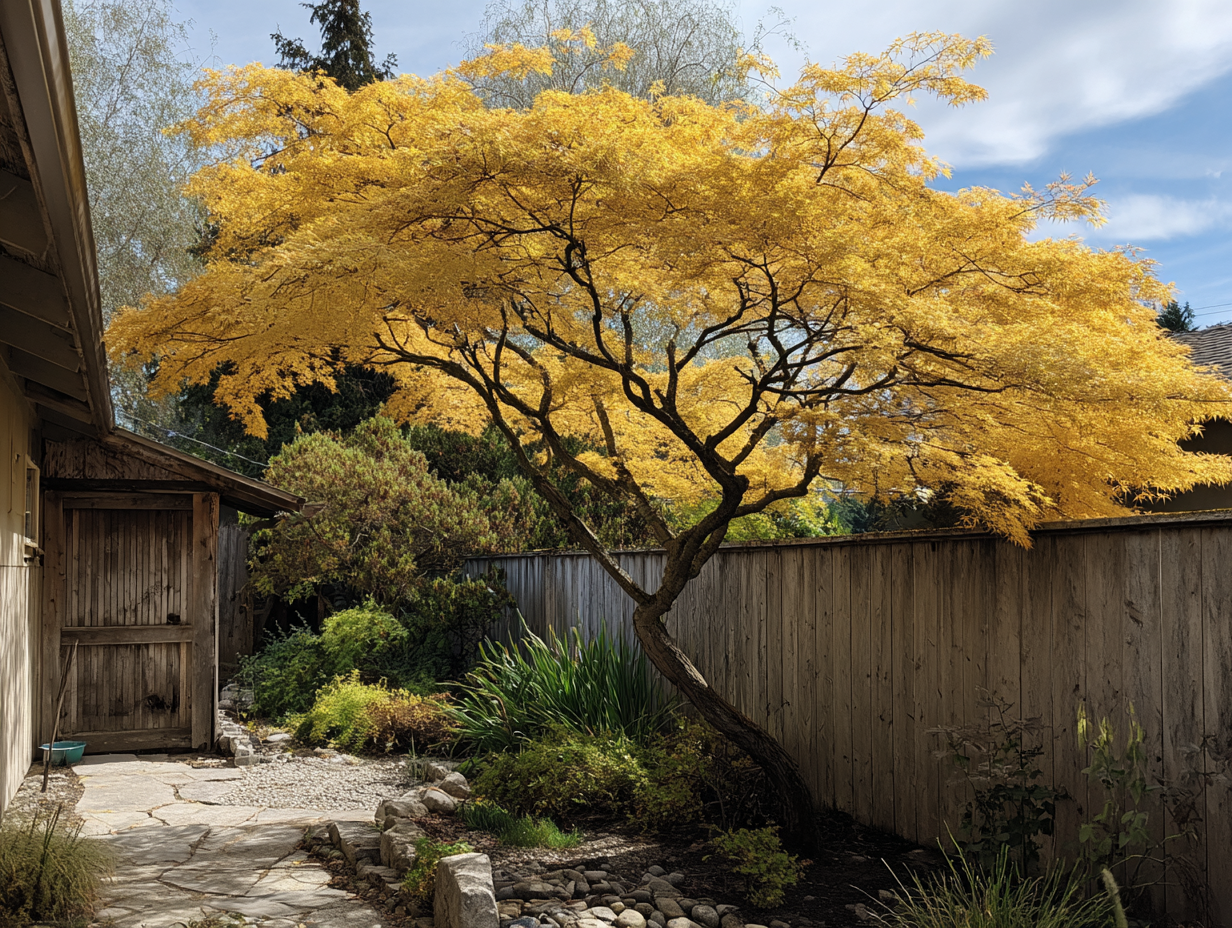
Shaping Japanese Maple Trees with a Bonsai Mindset
Why is it worth learning about bonsai styles if you have a Japanese maple?
1. Bonsai is not about size, but about mindset
Many people automatically associate bonsai with small trees grown in small containers. Yet the essence of bonsai is not the size, but the way we look at a tree. Bonsai teaches us that a tree is not merely a plant, but a form, a rhythm, and a story that unfolds over time. These principles apply just as well to a Japanese maple grown in a pot or in the ground.
When we approach a maple with a bonsai mindset, we don’t ask how to make it look beautiful quickly, but rather which direction it naturally develops, where its strength lies, and what future form it carries within itself. This way of thinking is liberating: it doesn’t constrain — it gives direction.
2. Understanding the tree comes before pruning
Most garden pruning is a reaction made on impulse. A branch is too long, the canopy too dense, it’s in the way — so we cut. Bonsai, by contrast, teaches patience and deliberation. We observe first, and only then do we intervene. In the case of a Japanese maple, a well-planned approach over time is especially important, because the species tends to densify quickly and lose its legible structure. If we learn to “read” the tree, we recognize which branch leads the eye, which one disrupts the balance, and which one will only detract from the overall picture in the long run. Pruning then becomes not a destructive intervention, but a gentle act of guidance. The tree doesn’t become smaller or sparser — it becomes more graceful, more elegant.
3. Bonsai styles as compasses, not rules
Bonsai styles are not templates to be forced onto a tree. They are much more like compasses that help us navigate the world of forms. For a Japanese maple with a gently undulating trunk, the informal upright way of thinking helps preserve its naturalness. For a tree leaning slightly toward the light, the logic of the slanted style gives meaning to what previously appeared to be a “flaw.”
These styles are not about turning a tree into a bonsai, but about not fighting its natural character. In this sense, bonsai does not impose form — it reveals it.
4. What changes when you look at a garden maple this way?
The shift in perspective that develops within you will not happen overnight — it takes practice and patience. A Japanese maple cared for with a bonsai mindset will, over time, develop a more open canopy with a more pronounced trunk line. The branches no longer work against each other, but together form a unified whole. The tree’s appearance becomes calmer, more harmonious, and it has an impact on the atmosphere of the entire garden.
The change doesn’t only happen in the shape of the tree, but in us as well. The rushing and over-intervention fade away. Patience and foresight emerge — like moves in a game of chess. A single pruning cut no longer solves the problem of the current year, but prepares the possibilities of the next five years.
5. You are not growing a bonsai — you are building a relationship
The bonsai mindset is, at its core, not a technique but a relationship. A relationship with the tree, with time, and with the consequences of our own decisions. A Japanese maple cared for in this way becomes not just a beautiful plant, but a vessel for a personal story. If you have a Japanese maple — whether in a pot or in the garden — learning about bonsai styles is not obligatory knowledge, but an opportunity. An opportunity not just to grow the tree, but to understand it. Not just to shape it, but to grow alongside it. And perhaps that is reason enough to grow trees at all.
Working with bonsai is a kind of meditation that teaches us to understand nature, to appreciate the simple joys of life, and to bring peace to our hearts. The goal is not dominion over nature, but the creation of a harmonious balance between the tree, the pot, and the surrounding environment.
Summary
The mindset and techniques learned through bonsai translate beautifully to Japanese maples grown in containers or in the ground. In fact, there is a close connection between the natural habit of Japanese maples and bonsai styles, since the very principle of bonsai is the imitation of forms found in trees growing freely in nature.
If you’d like to explore some bonsai styles that you can also apply in your garden, I recommend this article: The 8 most common bonsai styles for Japanese maples.