Winter Protection of Japanese Maple
How to prepare your Japanese maple for the cold months
Preparing for Winter Dormancy
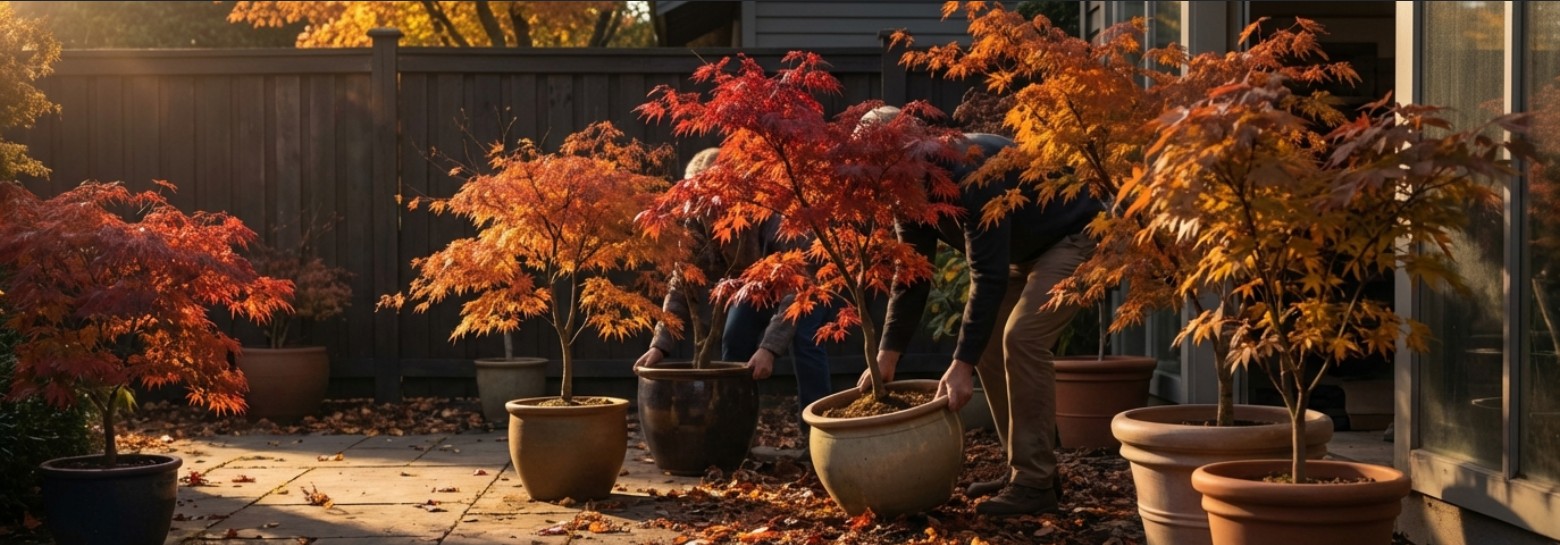
Japanese maples put on their most spectacular display as autumn arrives, when their foliage dresses itself in fiery colors. This color change is not merely an aesthetic experience, however — it is also an important signal: the tree has begun its dormancy cycle, and the time for winter preparation has come. The key to successful overwintering lies in the combination of timing and proper protection.
When Should We Start?
We have a window of approximately four to six weeks to carry out winter preparation before the trees sink into deep dormancy. The calm, mild days of early November are most suitable for this, as stable weather conditions support the necessary interventions. Once a significant portion of the canopy is already glowing in autumn colors, we can be certain that the tree has committed itself to its rest period.
Cleaning and Pest Protection
The foundation of winter health is hygiene. The following steps are worth carrying out:
- Remove weeds and moss from the soil surface. Moss, while it may be aesthetically pleasing, retains persistent moisture at the bark, which can cause bark rot — particularly in older specimens with rough bark.
- In early autumn, it is worth applying an oil-based or soap-based spray. This suffocates overwintering insect eggs on the branches, significantly reducing spring pest invasion. It is important to do this during dry weather.
- Garden hygiene: Clean the area around the plant of fallen leaves and debris to eliminate hiding places for pathogens.
Pruning and Shaping: What Is and Isn’t Allowed?
Larger structural pruning cuts should be avoided during autumn preparation. At this time, the tree’s sap flow has already receded, and it lacks the energy to seal large wound surfaces — which can open the door to infections.
- Remove only dead, diseased, or damaged parts.
- Always cut back to healthy tissue, then leave a bud so that the cut surface can dry out properly.
- Leave larger shaping cuts until the end of the winter dormancy period (March), when sap flow has completely stopped but has not yet resumed, and there is no risk of “bleeding.”
Protection Against Frost
Although the Japanese maple is fundamentally hardy, specimens grown in containers or bonsai pots are far more vulnerable than those planted in the ground.
- Placing on the ground: If temperatures consistently drop below –5 °C, take the pots off their stands and place them directly on the ground, which provides natural thermal insulation.
- Mulching: Protect the root zone with a 5–10 cm layer of mulch (straw, pine bark, dry leaves). This helps to even out soil temperature and retain moisture.
- Wind and sun protection: Frozen roots cannot absorb water, while the branches continue to transpire under the influence of wind and sun. Trees should be moved to a shaded, sheltered location.
- Indoor overwintering: Potted specimens can also be brought into an unheated garage, veranda, or garden shed where the temperature remains between 0–5 °C (maximum 8 °C). In a warmer location, the tree may break dormancy prematurely.
Insulating and Supplementary Techniques
- Wrapping the pot: Using bubble wrap or a burlap sack provides effective protection.
- Insulated boxes: For plants kept on a balcony, a good solution is to place the pot inside a larger box and fill the gap with bark chips or sawdust.
- Sinking the pot into the ground: Buried up to the rim of the pot and covered on top with leaf litter or straw, excellent thermal stability can be achieved.
- Choice of material: The natural insulating capacity of wooden boxes moderates the effects of frost over the long term.
- Insulated boxes: For plants kept on a balcony, an effective method is to place the pot inside a larger box and fill the gap with moist bark chips or sawdust.
- Lifting off concrete: Cold paving and concrete draw heat away from the pot, causing the root ball to freeze faster and more deeply. It is worth placing the pot on an insulating layer (wooden board, polystyrene, foam board, pallet) to reduce the cold coming from below and minimize temperature fluctuations.
- “Using” a snow cover: If snow falls, it is not an enemy — a loose layer of snow around the pot acts as natural insulation. (Heavy, wet snow should be brushed off the branches, however.) Melted snow, provided good drainage is ensured, does not cause problems.
- Positioning beside a north-facing wall: The north side of a building is more stable in winter, receives less direct sunlight, and therefore carries a lower risk of daytime warming and overnight refreezing — that is, temperature fluctuation.
The essence of winter protection is balance: the goal is not to provide heat, but to insulate the root zone and prevent the branches from drying out. Another aspect of winter rest is that we should not move or rotate the pot while it is frozen — brittle roots can sustain micro-injuries with ease.
The Phenomenon of Winter “Desiccation”
One of winter’s most dangerous conditions is when the tree can quite literally “die of thirst” even in the presence of abundant moisture. If the root zone freezes completely, the plant is unable to absorb water, while the branches continue to transpire under the influence of wind and sun.
It is as if we were trying to quench our thirst in a desert with a water bottle frozen in a block of ice: the water is there, but it is unreachable. This is why wind protection and root zone insulation are so critical.
Winter dormancy is not the cessation of life, but nature’s humble dialogue with time and the beauty of impermanence. Just as the maple releases its leaves, it teaches us — in the spirit of wabi-sabi — the quiet virtue of patience and the power of renewal.
Related articles:
- Bonsai energy management - Learn why preserving the tree’s energy reserves over winter is critical