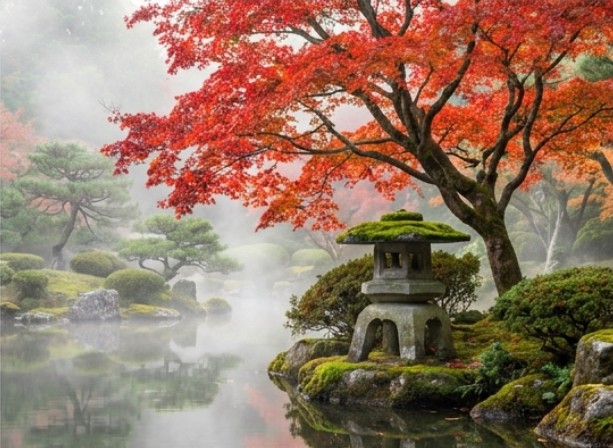
Japanese Garden - The Perfect Reflection of Nature
Essential aesthetic and philosophical principles of Japanese garden design
Japanese garden art is not merely a collection of horticultural techniques, but a complex aesthetic, philosophical, and sacred system that seeks to capture the ideal forms of nature. For the beginning garden builder, the first and most important realization is that the Japanese garden is a kind of “three-dimensional painting,” where the designer uses plants, rocks, and open spaces the way an artist uses colors on a palette. In this article, I will introduce the constituent elements of the Japanese garden, their deeper cultural symbolism, and the plant palette suited to Hungary’s climate.
The Philosophical and Historical Foundations of Japanese Garden Architecture
The roots of Japanese garden culture are found in the island nation’s indigenous religion, Shinto, as well as in Buddhism and Taoism that arrived from continental Asia. According to the animistic worldview of Shinto, every element of nature — uniquely shaped rocks, ancient trees, and waterfalls — is the dwelling place of deities (kami). The garden (niwa) originally meant a purified, gravel-covered sacred space prepared to receive the gods.
Buddhism, particularly its Zen branch, elevated garden-making into an instrument of meditation and self-knowledge. It was during the Muromachi period (1338–1573) that the karesansui — the dry rock garden — became dominant, representing the universe at the highest level of abstraction, using only stones and sand, without water. Parallel to the development of the tea ceremony, the chaniwa (tea garden) emerged as a setting for inner tranquility and ritual purity.
The Shift in Mindset
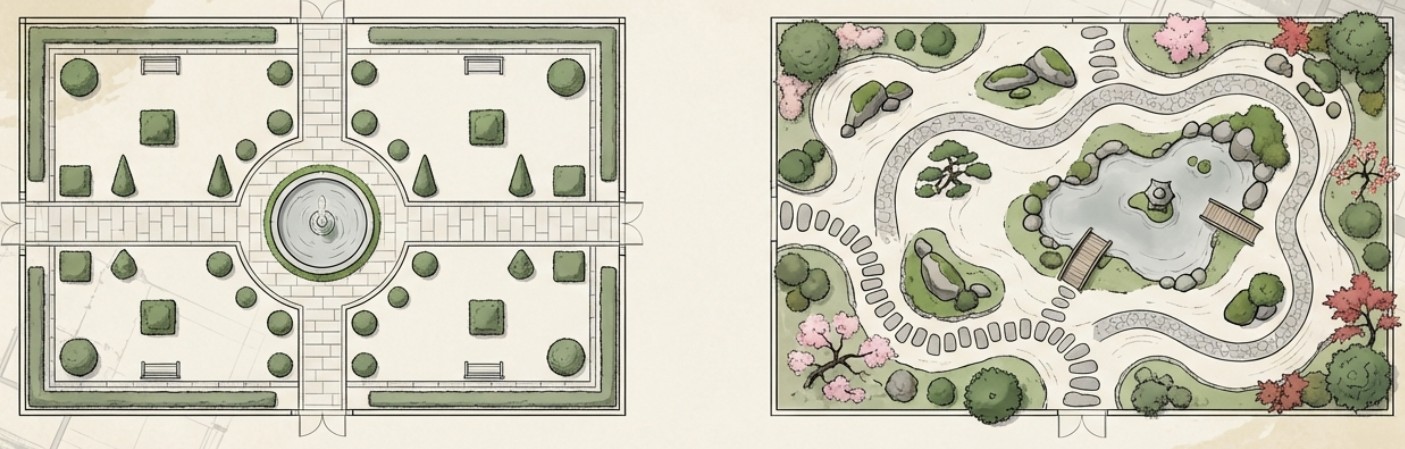
Harmony instead of dominion. While the Western, formal garden approach emphasizes humanity’s mastery over nature, the Japanese garden seeks to capture the essence and ideal forms of nature. Its hallmarks are asymmetry, organic forms, and respect for the invisible order of nature. The Japanese garden is an essential reflection of the universe. Rocks compress mountains, and ponds compress oceans into a single space. It is an idealized, disciplined presentation of nature’s most expressive moments, free from unnecessary physical noise.
Core Aesthetic Categories
When designing a Japanese garden, four key concepts define the spatial experience:
- Ma (Pause, negative space): Empty space does not signify an absence, but rather an active compositional element that allows the eye to rest and highlights the focal objects.
- Wabi-sabi: The aesthetic value found in imperfection, transience, and the beauty of patina caused by time (such as moss settling on stones).
- Fukinsei (Asymmetry): The pursuit of natural balance by avoiding artificial symmetry. A Japanese gardener never places an even number of elements or a mirror-image arrangement.
- Shizen (Naturalness): The concealment of human intervention. The goal is for the garden to feel as though the landscape formed on its own, rather than having been born at a drafting table.
| Garden Style | Name | Primary Function | Characteristic Elements |
|---|---|---|---|
| Karesansui | Dry garden | Meditation, contemplation | Raked sand, rocks |
| Tsukiyama | Hill garden | Scenery, strolling | Artificial hills, ponds, bridges |
| Chaniwa | Tea garden | Preparation for the tea ceremony | Stepping stones, stone basin, lantern |
| Tsuboniwa | Courtyard garden | Decorating small spaces | Minimal planting, decorative stones |
| Kaiyushiki | Stroll garden | Social life, relaxation | Winding paths, alternating viewpoints |
Structural Elements of the Garden: The Symbolism of Rocks and Stone
Stones form the “skeleton” of the Japanese garden; they convey stability, strength, and eternity. Classical texts, such as the 11th-century Sakuteiki, refer to the process of garden-making as “setting stones” (ishi wo taten koto). The selection and placement of stones (ishigumi) carries deep spiritual meaning.
The Art and Rules of Ishigumi
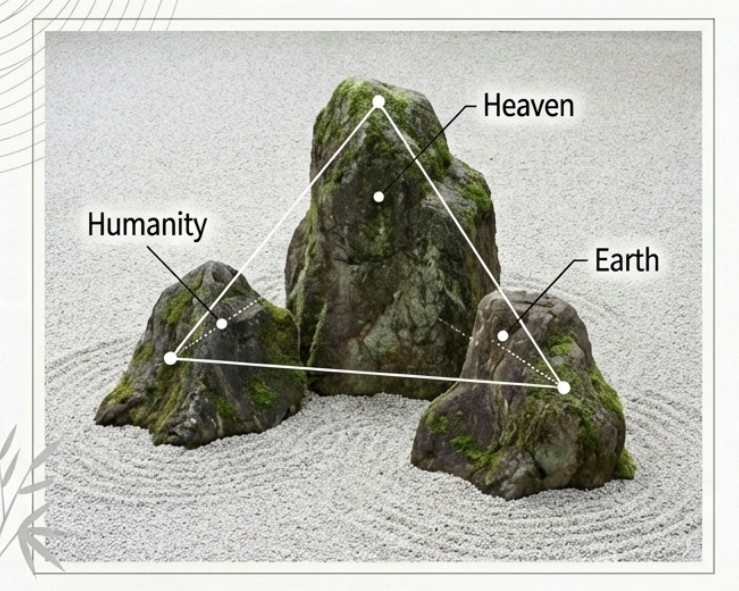
Stones are not scattered randomly, but placed in a strict hierarchical order. The most important arrangement is the sanzon ishigumi, or Buddhist trinity: a central, tall, vertical stone represents the deity (or heaven), while two smaller stones support it from the sides, symbolizing humanity and the earth.
By type, stones are distinguished as follows:
- Tall vertical stones: Symbolize mountain peaks or energy striving toward the sky.
- Low vertical stones: Provide stability to the composition.
- Recumbent or horizontal stones: Represent islands, the earth, or tranquility.
- Arched or curved stones: Introduce movement and dynamism into the composition.
The beginning garden builder should avoid so-called “taboo stones.” These include “sick stones” (with a distorted top), “dead stones” (vertical stones set in an unnatural direction), and “beggar stones” (those with no visual connection to the other elements). Stones must be set so that at least one-third of them is buried underground, creating the impression that the rock is emerging from the depths and has been there since time immemorial.
Stepping Stones and Paths (Tobi-ishi)
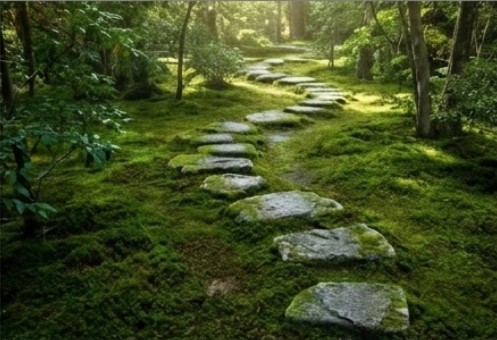
Paths in the Japanese garden symbolize the journey of life. The arrangement of stepping stones (tobi-ishi) determines the visitor’s pace and the direction of their attention. Where the stones are larger and flatter, the gardener encourages the observer to stop and take in the panorama. Paths are rarely straight; the winding course serves to keep evil spirits at bay (who, according to folk belief, can only travel in straight lines) and to expand the sense of space.
Sacred Ornamentation
The function of decorative elements is to create a balance between nature and the built environment. They are never gratuitous; they always serve a deep spiritual purpose.
Stone lanterns (Toro) originally served to illuminate the paths of tea gardens. Their form symbolizes the four natural elements of Buddhist cosmology (Earth, Water, Fire, Air) — guiding lights of the spirit.
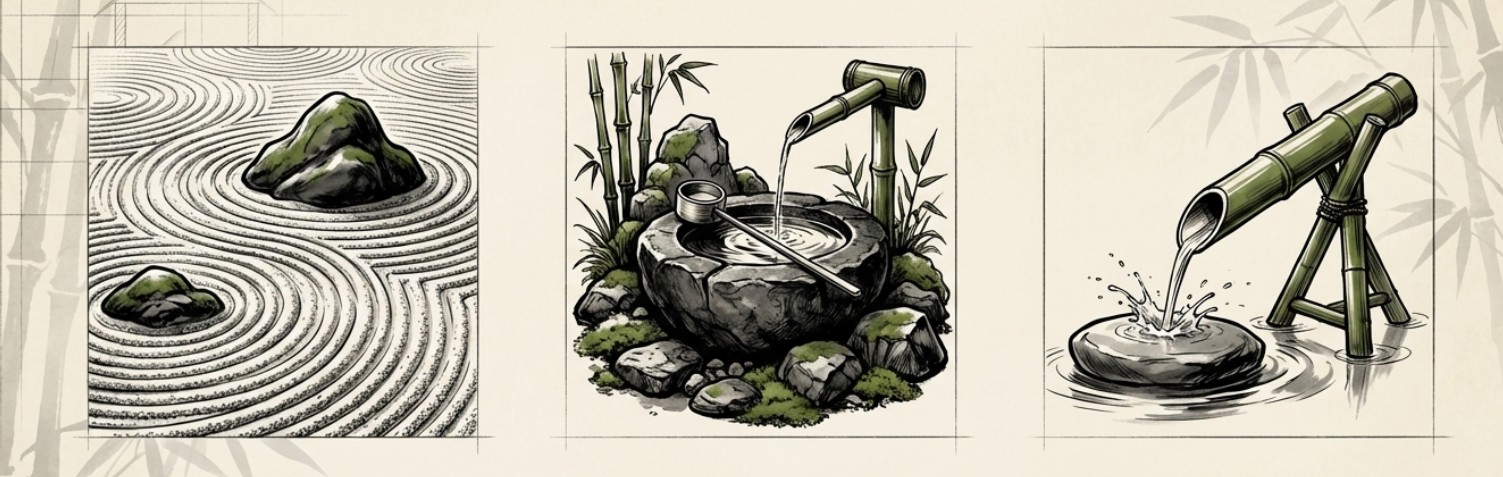
The stone basin (Tsukubai) is the site of ritual purification before the tea ceremony. The name derives from the word for crouching — its low placement physically compels the visitor to humility.
Gates (Torii) and fences do not serve protective purposes. They are mental boundary lines, symbolizing the exclusion of the noise of the profane outside world and the entry into the sanctuary of inner peace.
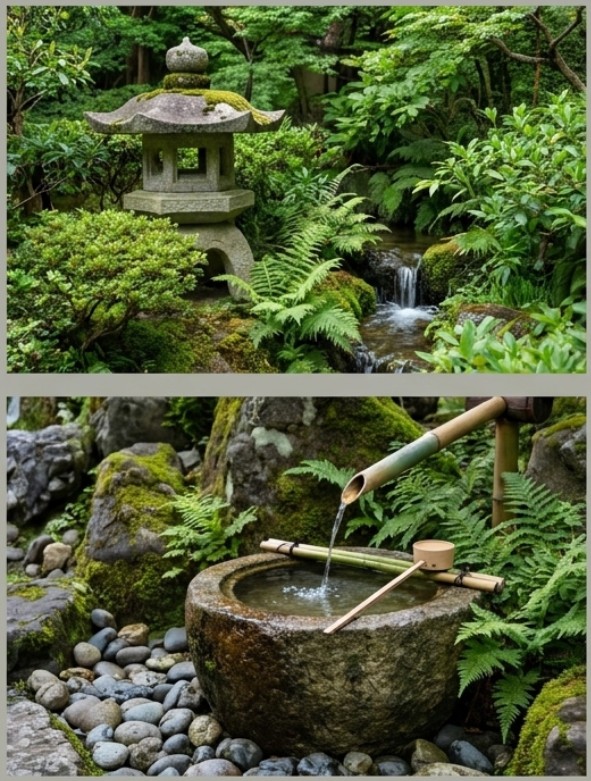
The Role and Symbolic Representation of Water
Water symbolizes purity, the cycle of life, and renewal. In an authentic Japanese garden, water must flow, and its sound masks the noise of the city, facilitating inner contemplation.
Types of Water Elements
- Ponds and islands: The shape of ponds is always asymmetric. They often contain an island symbolizing the mythical Mount Horai, the abode of the immortals.
- Waterfalls: The Sakuteiki describes ten different waterfall arrangements. It is important that the waterfall face the moon if possible, so that the moonlight can be reflected in the cascade.
- Karesansui (Dry water): In gardens where real water is not feasible, white sand or fine gravel is used to simulate water. Raked lines represent the waves of the sea or the flow of rivers.
- Shishi-odoshi (Deer scarer): This bamboo device originally served to keep animals away, but its rhythmic clacking has become one of the garden’s most distinctive meditative sounds.
Plant Selection and Seasonality
In the Japanese garden, plants are selected not for the color of their flowers, but for their texture, form, and response to the changing seasons. The goal is to create a “filtered reality” in which the plants represent the essence of forests and mountains.
Dominant Species and Their Meanings
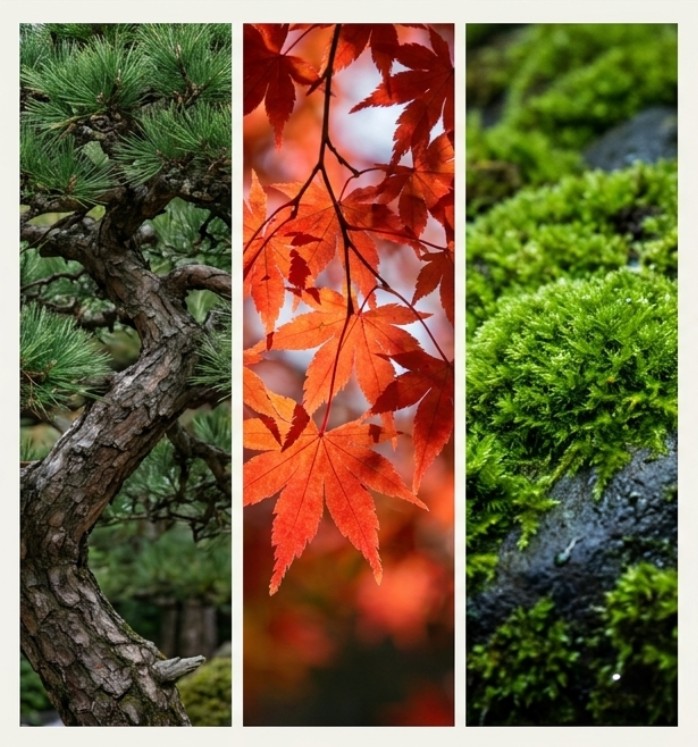
- Pine (Matsu): The evergreen pine is a symbol of longevity and steadfastness. It is often pruned into a “cloud form” (niwaki) to evoke the image of an aged, storm-weathered tree.
- Japanese maple (Momiji): With the dramatic colors of its autumn foliage, it serves as a reminder of life’s transience.
- Bamboo: Its flexibility and rapid growth make it a symbol of purity and uprightness. It also functions as a fence or windbreak.
- Moss: Evokes a sense of tranquility and ancient origins. The Japanese regard moss not as a weed but as a valuable ground cover.
- Cherry tree (Sakura): Spring blossom is a symbol of renewal and ephemeral beauty.
Adapting to the Hungarian Climate
The beginning garden builder in Hungary must take into account that the Japanese climate is more humid and even than the continental climate of home. Substituting certain species or providing specialized care is essential for success.
| Japanese Species | Hungarian Alternative | Notes |
|---|---|---|
| Azalea | Rhododendron hybrids | Requires acidic soil (type-A soil) |
| Moss | Round-leaved birthwort, Cushion moss | Viable in shaded spots with irrigation |
| Bamboo | Fargesia species (non-invasive) | Root barrier mandatory for other species |
| Japanese maple | Katsura or Beni-otake cultivars | Plant in semi-shade, sheltered from wind |
| Taxus cuspidata | Taxus baccata (English yew) | Excellent for training as niwaki |
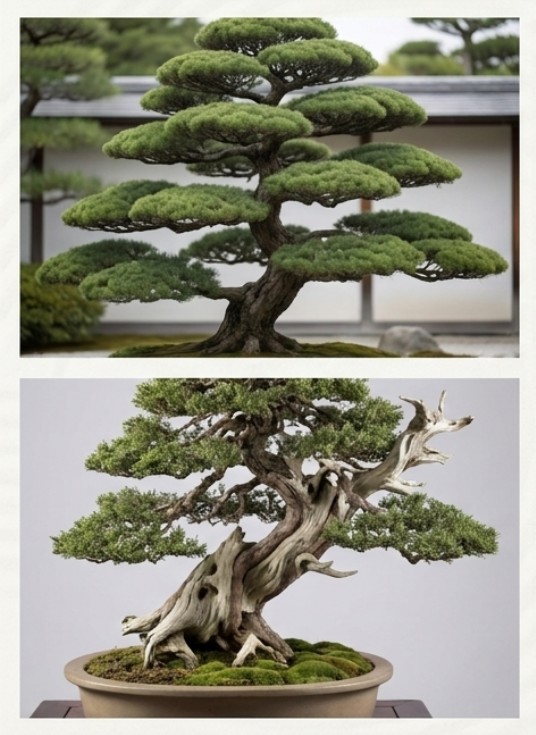
Training Ornamental Trees in the Bonsai Style:
When cultivating bonsai and ornamental trees, the goal is for the tree to reflect the passage of time and its struggle with the forces of nature.
- Chokkan (Formal upright): A straight trunk conveying the dignity of the tallest tree in the forest.
- Shakan (Slanting trunk): Imitates a tree leaning toward the wind or the light.
- Kengai (Cascade): The trunk bends below the rim of the pot, as if hanging from a steep cliff face.
Closing Thoughts
There is something extraordinary, inexplicable harmony in such a garden that fills the visitor with a singular feeling when they step into a well-composed Japanese garden. Whether someone builds the garden at home from its characteristic elements, that same sense of calm and continuous growth accompanies the experience.
It is important to understand: a Japanese garden is never finished, just like a bonsai. Its design and construction are only the first step in a lifelong process.
Time, as designer, helps it become an authentic and valuable garden; the growth of moss, the patina of stones (sabi), and the aging of trees are what truly give the space its worth. Our garden requires constant tending, which cannot be an obligation, but must itself be the meaning of existence. Raking gravel and sweeping fallen leaves is the daily ritual of self-knowledge — the perfect form of humility and our connection to nature.
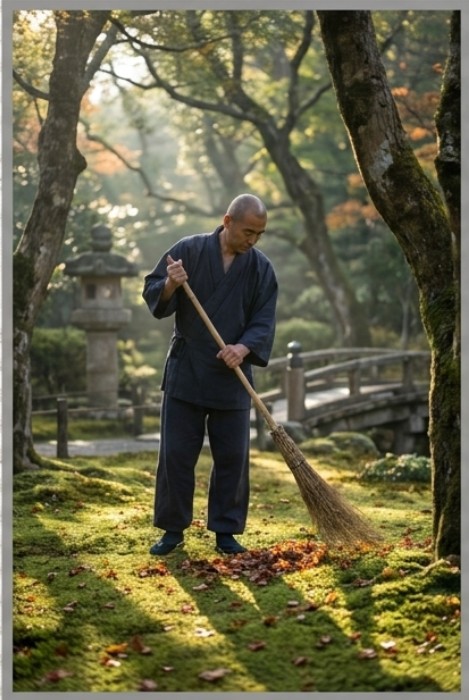
The more you look, the more you see — and the more you find within yourself.
Japanese garden - Elements, Types, Examples, & Pictures - Britannica
A japánkertek felépítése - Japánkert
A Generational Artform: Learn More About Bonsai at Portland Japanese Garden
The Japanese Zen Garden - Different Types, Elements and Pictures - Discover by Silversea
Understanding the Art of Japanese Gardening
Japanese dry garden - Wikipedia
Japanese Garden Ideas UK - Japanese Style Garden Design
5 különleges japán kertészeti tipp, amivel a te kerted lehet a legszebb a környéken! - Ötletmozaik
Japanese Garden Design Principles: Elements, Zen, Wabi-Sabi
Japanese Garden Ideas for a Serene, Zen-Inspired Yard - Garden Design
Principles of Japanese Garden Design - PDF - Zen - Religion And Belief - Scribd
Japánkert tervezése magyar éghajlatra - A Kertem - Kert Magazin
Japanese Garden Design: a Primer
Tranquility in Your Backyard: Mastering the Art of Japanese Garden Design
Az 5 legfontosabb elem egy Japán Kertben… - NIWA Kert
Stone Arrangement in Japanese Gardens
Garden Elements - Part 2 - Samurai Tours
What Are the Key Elements of a Japanese Garden Design? - JC Landscaping Inc.
The Complete Japanese Garden Landscaping Guide
| [Elements of the Japanese Garden | Space for life](https://espacepourlavie.ca/en/elements-japanese-garden) |
How to Create a Japanese Garden: Expert Tips & Tricks - TW Aggregates
Kerti bonsai - Niwaki - Mujo garden