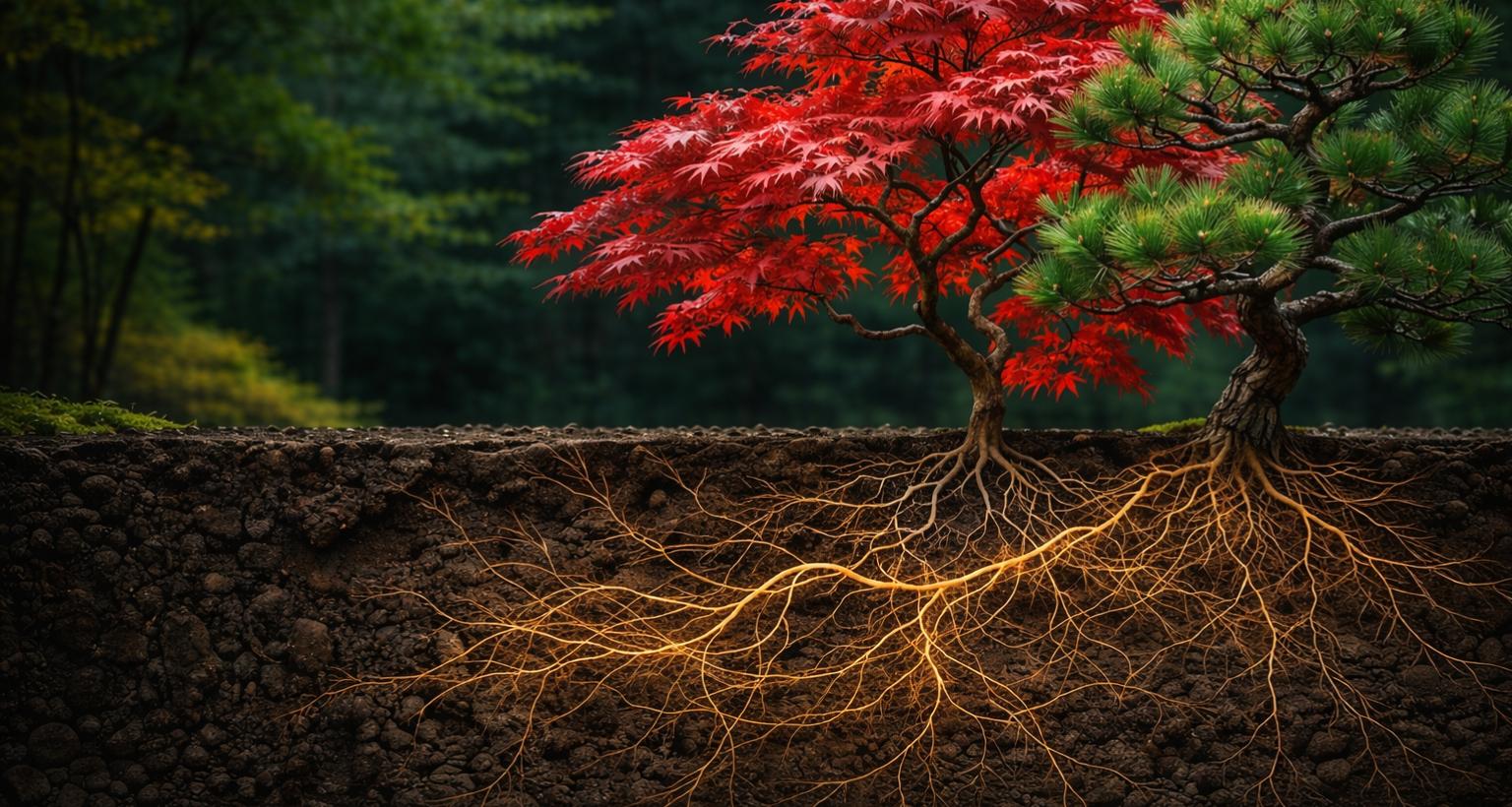
The Invisible Helpers of Plants
Everything Worth Knowing About Mycorrhizal Fungi
A Scientific Analysis of the Symbiosis Between Mycorrhizal Fungi and Woody Plants, With Special Attention to Japanese Maples and Conifers
One of the most important yet invisible events in the evolution of life on Earth occurred approximately 450 million years ago, when plants first colonised dry land. This conquest could not have happened without the alliance forged with mycorrhizal fungi. The term — derived from the Greek words “mykes” (fungus) and “rhiza” (root) — describes a mutualistic symbiosis in which fungus and plant mutually support each other’s survival. The plant provides carbohydrates, sugars, and vitamins produced during photosynthesis, while the fungus, through its extensive hyphal network, delivers water and mineral nutrients — primarily phosphorus (P), nitrogen (N), and micronutrients — to the host plant. According to current knowledge, approximately 82–92% of terrestrial plant species engage in this type of relationship, revealing that mycorrhiza is not the exception but the general physiological rule in nature.
Taxonomic and Physiological Classification of Mycorrhizal Symbiosis
Science distinguishes several major categories based on the nature of the anatomical relationship between fungal hyphae and root cells. From a horticultural and forestry perspective, the two most important are arbuscular mycorrhiza (endomycorrhiza) and ectomycorrhiza. The difference is not merely morphological but also taxonomic, as different fungal phyla and plant families are involved.
Arbuscular mycorrhiza (AM) is the most widespread form, affecting the majority of herbaceous plants and numerous woody genera, including maples (Acer). In this relationship, fungal hyphae penetrate the walls of root cells, forming specialised branching structures known as arbuscules. These arbuscules are the primary sites of nutrient exchange, where the plant membrane and the fungal membrane come into close proximity, enabling efficient molecular transport. Because the fungus resides within the cells, its presence is invisible to the naked eye.
Ectomycorrhizal (ECM) fungi, by contrast, do not penetrate the cell interior; instead, they form a thick fungal mantle on the root surface and establish a network known as the Hartig net within the intercellular spaces. This type is characteristic of conifers (Pinaceae), oaks (Quercus), beeches (Fagus), and birches (Betula). ECM fungi frequently produce conspicuous fruiting bodies — the well-known capped mushrooms — on the forest floor.
| Property | Arbuscular Mycorrhiza (AM) | Ectomycorrhiza (ECM) |
|---|---|---|
| Fungal phylum | Glomeromycota | Basidiomycota, Ascomycota |
| Anatomical structure | Arbuscules, vesicles | Hartig net, fungal mantle |
| Cell penetration | Intracellular | Extracellular (between cells) |
| Visibility | Microscope only | May be visible to the naked eye |
| Main host plants | Maple, ash, fruit trees, vegetables | Pine, beech, oak, birch |
The Japanese Maple (Acer palmatum) and Its Mycorrhizal Relationship
In ornamental garden applications, supporting soil life is of fundamental importance for the Japanese maple (Acer palmatum). The maple genus is an obligate partner of arbuscular mycorrhiza (AM), meaning that in their natural habitat, development without this symbiosis is virtually unimaginable. Japanese maples are shallow-rooted and particularly sensitive to environmental stress, such as drought or soil compaction.
The presence of mycorrhizal fungi in the Japanese maple dramatically increases the absorptive surface area of the root system — by some estimates up to 700-fold. Fungal hyphae are far thinner than plant root hairs, allowing them to penetrate even the smallest soil pores and mobilise water and nutrients that would otherwise be inaccessible to the plant. This capability is especially critical for the Japanese maple, which thrives in evenly moist yet well-draining soils. The mycorrhizal network functions as a buffer: delivering water during drought and storing nutrients during periods of abundance.
Among the physiological benefits is enhanced phosphorus uptake. Phosphorus is often present in the soil in bound, insoluble forms (such as calcium or iron phosphates) that plant roots cannot directly absorb. AM fungi secrete organic acids and enzymes that break these bonds, delivering phosphorus directly into the root cells. In addition, the fungi produce a glycoprotein called glomalin, which acts as a “biological glue,” binding soil particles together and improving soil structure and aeration — both essential for healthy root development in Japanese maples.
The Specialised Ectomycorrhizal Requirements of Conifers (Pinaceae)
The physiological strategy of conifers (Pinaceae family, including Pinus, Picea, Abies, Larix) differs fundamentally from that of maples. For them, ectomycorrhiza (ECM) is the defining and indispensable form of association. Conifers are so dependent on these fungi that without mycorrhiza, seedlings frequently yellow, cease growing, and ultimately perish. In the ECM relationship, the fungus forms a visible mantle around short, modified root tips, which often appears as a white, silky coating when transplanting.
In conifers, one of the most important functions of the symbiosis is the uptake of nitrogen from organic sources — a crucial survival advantage in forest soils where decomposition is slow. ECM fungi are capable of breaking down complex proteins and amino acids, transferring nitrogen to the tree. A further significant difference is that the ectomycorrhiza of conifers also provides physical protection: the thick fungal mantle forms a mechanical barrier against pathogenic fungi (such as Fusarium or Pythium) and nematodes.
An interesting phenomenon in conifers is the so-called ectendomycorrhiza, which is characteristic mainly of Pinus and Picea genera. This is a transitional form in which, alongside the Hartig net, hyphae also penetrate the cell interior to a limited degree. This flexibility allows conifers to establish themselves even on extremely harsh, nutrient-poor, or acidic soils.
The success of the symbiosis can be inferred from the following indirect signs: Striking development and colour: Japanese maples successfully colonised by fungi reward the fungi’s presence with healthier foliage, more vibrant leaf colour, and more vigorous growth.
- The plant tolerates environmental challenges better — such as summer heat, drought, or transplant shock — because fungal hyphae can increase the root’s absorptive surface area up to 700-fold.
- Mycorrhizal fungi produce a protein called glomalin, which acts as a “biological glue.” If the soil around the maple becomes more crumbly, better-draining, and more aerated, this points to active fungal activity.
- Colonisation typically begins within 2–4 weeks, but visible positive changes in the plant may take several months to appear.
An important distinction from other tree species: While in conifers (ectomycorrhizal type), a white, cotton-like coating or silky mass of fungal threads on the root tips signals success, no such external sign will be found on the roots of Japanese maples. If white tufts appear on a maple’s roots, this is not the maple’s own mycorrhiza (but possibly another fungus or pest), since the maple’s fungal partner lives within the cells.
A lifelong alliance: The literature emphasises that this is a lifelong relationship. Once the symbiosis has been successfully established, the fungus need only be introduced once in the plant’s lifetime, and the relationship persists through subsequent transplantings. It is important to understand, however, that although the maple “carries” the fungus in its roots, the extensive external hyphal network (the “Wood Wide Web”) present in the soil is severed during transplanting. In the new location, the plant must rebuild this external network with the help of the fungal partner carried in its roots, in order to once again efficiently absorb water and nutrients.
A risk during transplanting: Although the fungus lives within the root, bare-rooting — completely washing away or drastically removing the growing medium (for example in bonsai cultivation) — can stress the plant and the symbiosis so severely that it damages this beneficial alliance. This is why it is recommended that some of the old soil always remain in the root zone during transplanting, or that a fresh dose of inoculant be used to reduce stress.
Is Mycorrhiza Present in the Soil of a Nursery-Bought Maple?
Not necessarily. Although it is common in nature, the following factors mean it may frequently be absent in horticultural cultivation:
- Nurseries and tree farms often use sterile peat or artificial soil mixes (e.g. akadama, kiryu for bonsai) that are originally free of beneficial fungi.
- If the plant is abundantly supplied with readily available (especially phosphorus-rich) synthetic fertilisers, the plant becomes “complacent” and stops secreting the signalling compounds that would invite the fungus into its roots. In this case, the symbiosis fails to develop, or any existing fungus starves.
- Plant protection treatments (fungicides) can also destroy beneficial mycorrhizae in the soil.
Can a Maple Survive Without Mycorrhiza?
Yes, it can survive, but with significant disadvantages:
- If the gardener continuously supplies water and fertiliser (“hand-delivers everything”), the plant can remain alive without the fungus’s help.
- Without mycorrhiza, plants lose their natural resilience, become more susceptible to disease, and live shorter lives.
- Without a fungal partner, Japanese maples struggle far more with summer heat, drought, or soil compaction.
- Experiments (conducted with conifers) have demonstrated that while individuals living with the fungus were deep green and vigorous, their counterparts in sterile soil yellowed and fell behind in development.
Practical Methods for Establishing Mycorrhiza
The fundamental prerequisite for successfully establishing mycorrhizal fungi is direct contact between spores or hyphae and living plant roots. Spores do not move actively through the soil, so simply spreading them on the surface will not result in symbiosis.
Establishment at the Time of Planting
Planting new specimens is the ideal moment for inoculation. The root system is accessible, and the fungus can assist the plant from the very beginning in overcoming transplant shock.
- Applying granular preparations: Spread an even layer of mycorrhizal granules at the bottom of the planting hole, then place the plant’s root ball directly on top.
- Powder-based inoculation: The powder can also be applied directly to the moistened root ball, ensuring adhesion.
- Root dipping (Gel technology): For bare-root trees — such as forestry conifer seedlings — the most effective method is a mycorrhizal suspension mixed with a gelling agent. Dipping the roots in this thick solution ensures the fungus reaches every root tip.
- Seed treatment: When sowing, seeds can be mixed with mycorrhizal powder or the powder can be spread in the seed drill, so that the germinating root immediately encounters its symbiont.
Treating Existing, Already-Planted Specimens
Many garden owners face the challenge of wanting to support an already-planted Japanese maple that may be stagnating. Although treating an established tree is more complex, several effective techniques exist.
- Core Aeration method: At the tree’s drip line (at the edge of the canopy), where the most active feeder roots are found, holes 15–25 cm deep are drilled or punched into the soil at 50–80 cm intervals. The granular or liquid preparation is introduced into these holes, which are then backfilled and thoroughly watered.
- Deep root injection: A professional arborist technique in which high-pressure equipment at 150–200 psi injects liquid mycorrhizal suspension 20–30 cm deep into the soil. This method not only delivers the fungus to the roots but also loosens compacted soil.
- Drenching: In loose, sandy soils, water-soluble spores can be washed down into the root zone, but this method is less effective in heavy, compacted soils.
Supporting the Symbiosis: What to Do and What to Avoid
Mycorrhizal fungi are living organisms whose survival depends on environmental conditions. If conditions are not suitable, the fungus becomes inactive or perishes.
Beneficial Factors

Organic matter: Compost, mulch, and well-rotted organic manure feed soil life and maintain moisture, which favours hyphal growth.

Ideal pH (5.5–6.5): A mildly acidic environment is the most active zone for both the maple and the fungus.

Settled irrigation water: Allow tap water to stand for 24 hours so that the chlorine evaporates. Mulching protects the fungi from desiccation and direct UV radiation.
Factors to Avoid
High-phosphorus fertilisers: When the soil is saturated with soluble phosphorus, the plant "starves" the fungus by halting the supply of sugars, leading to the fungus's death.
Systemic fungicides: Since mycorrhiza is itself a fungus, most soil-applied fungicides are harmful to it. Systemic products are particularly dangerous, as they travel from the leaf down into the root where they take effect.

Chlorinated water and soil disturbance: When using chlorinated tap water, the disinfecting action of chlorine can destroy the delicate fungal threads. Digging and hoeing mechanically rupture the hyphal network — the foundational principle of mycorrhiza-friendly gardening is minimal soil disturbance.
Application in Container Plants and Bonsai Cultivation
Plants grown in pots or bonsai trays live in an isolated system where natural soil life is often entirely absent due to the sterile growing media used (such as akadama, kiryu, or peat).
Why is mycorrhiza important for bonsai? The root system of bonsai develops in a confined space, and frequent watering leaches out nutrients. Mycorrhizal fungi stabilise this environment.
- The fungi act as a buffer, helping the plant absorb nutrients continuously even when the soil is becoming depleted.
- Container plants can dry out within hours during summer. The hyphal network helps extract the last drop of water from the pores, preventing lasting damage.
- The regular root pruning and repotting of bonsai is a major source of stress. Mycorrhiza assists in wound healing and the rapid formation of new feeder roots.
In the case of conifer bonsai, the presence of mycorrhiza is often visible to the naked eye as white tufts. When repotting, never wash all the old soil completely from the roots (bare-rooting), as this destroys the fungal culture; always retain a small amount of old soil to mix into the new growing medium.
Dosage for container plants:
| Pot/Container volume | Mycorrhiza quantity (e.g. Symbivit) |
|---|---|
| Up to 1 litre (small bonsai/pelargonium) | 15 g (1 measuring spoon) |
| 3–5 litres (medium container) | 45–75 g (3–5 measuring spoons) |
| Over 10 litres (large tub) | 120 g+ (8 measuring spoons+) |
Fungicide Compatibility with Mycorrhiza
A critical question in professional plant protection is which products can be used without harming mycorrhiza. Research indicates that contact products sprayed onto foliage are generally safe, while soil-applied or systemic products carry significant risk.
Ecological Networks: The Wood Wide Web
The significance of mycorrhiza extends beyond the level of the individual plant. In forests, fungal hyphae connect the roots of multiple neighbouring trees, creating a vast underground communication network. Through this network, trees exchange not only information (such as pest alerts) but also nutrients. It has been demonstrated that older “mother trees” send extra sugars and nutrients through the mycorrhizal network to their own offspring growing in shade, aiding their survival. This system is also responsible for the stability of forests and the soil’s carbon sequestration capacity, as the fungi store carbon in the soil long-term in the form of glomalin.
Peter Wohlleben - The Hidden Life of Trees: What They Feel, How They Communicate — Discoveries from a Secret World
Ranges of trees and mycorrhizal status - tallcoleman
Mycorrhizal types - David Moore’s World of Fung
Deep Root Fertilization: Nourishing Your Trees from the Ground Up
Fungicides for Disease Management in the Home Landscape
Molecular interactions of Trichoderma: from microbial competition to soil health promotion
Gomba gombának farkasa: Trichoderma-alapú mikofungicidek a biológiai védekezésben
Effects of Nitrogen and Phosphorus Levels on Arbuscular Mycorrhizal Symbiosis MDPI