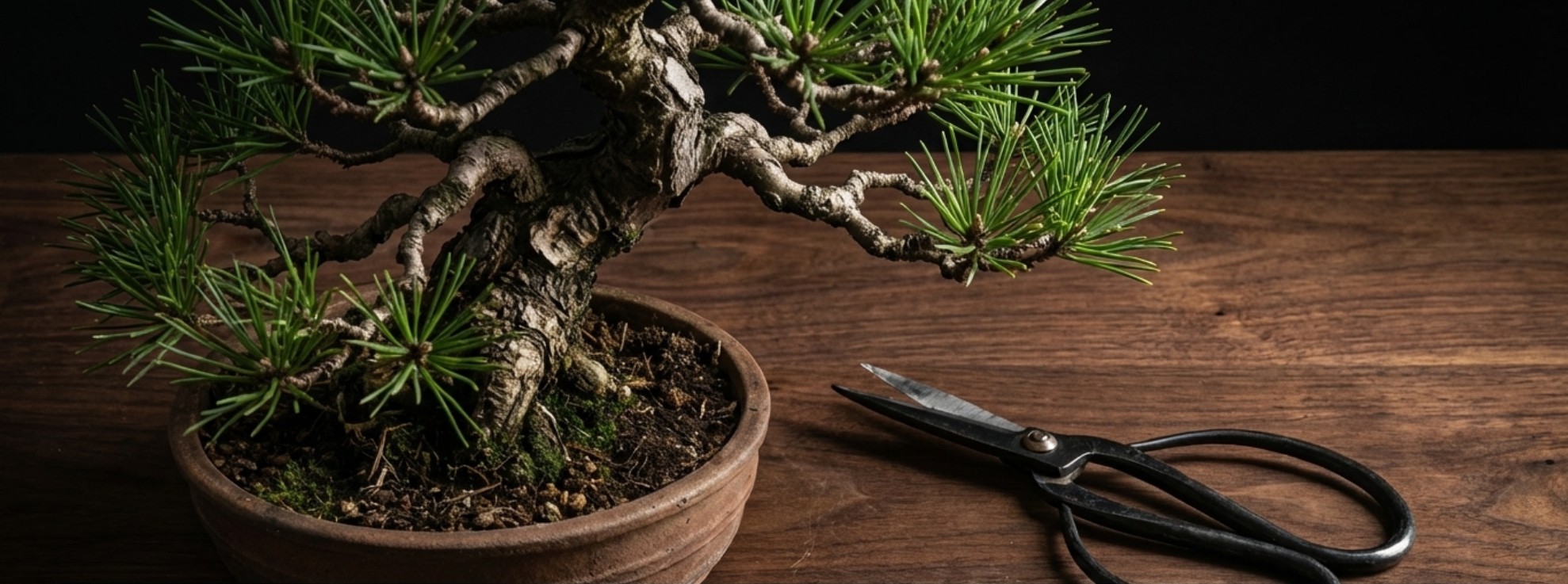
Analyzing the Quality of Bonsai Tools
The Synergy of Precision Metalworking and Plant Physiology
The art of bonsai is not merely a routine horticultural activity, but rather an interweaving of plant physiology and technical precision where every single intervention has a direct impact on the long-term health and aesthetic appearance of a living organism. The boundary between beginner and advanced level is often defined by the quality of tools and the respect shown toward them.
When the question arises as to whether the price difference between a low-cost, mass-produced tool and a traditional Japanese handcrafted product matters, the answer lies not only in the durability of the instrument, but in the tissue responses of the tree, the speed of healing processes, and the ergonomic strain on the bonsai artist. The tools used in professional bonsai cultivation — concave branch cutters, specialized scissors, and precision watering cans — are the result of centuries of metallurgical and horticultural experience, designed to minimize trauma to plant tissue and support physiological processes.
The Plant Physiology of Cutting Precision and Wound Healing
Every cut made during the shaping of bonsai trees is also a surgical intervention. The plant tissue’s response to a cut fundamentally determines the tree’s future growth vigor and the quality of scar formation. The use of low-quality tools — often made from unsuitable materials, poorly aligned, and dull — results not in a clean cut but in tissue crushing at the cut surface.
This mechanical trauma leads to the compression of the cambium layer, the plant’s meristematic tissue. When cambium cells are not cleanly separated but instead shattered under pressure, the integrity of the cell walls is lost, and the moisture stored within the cells immediately seeps out, leading to local necrosis (tissue death).
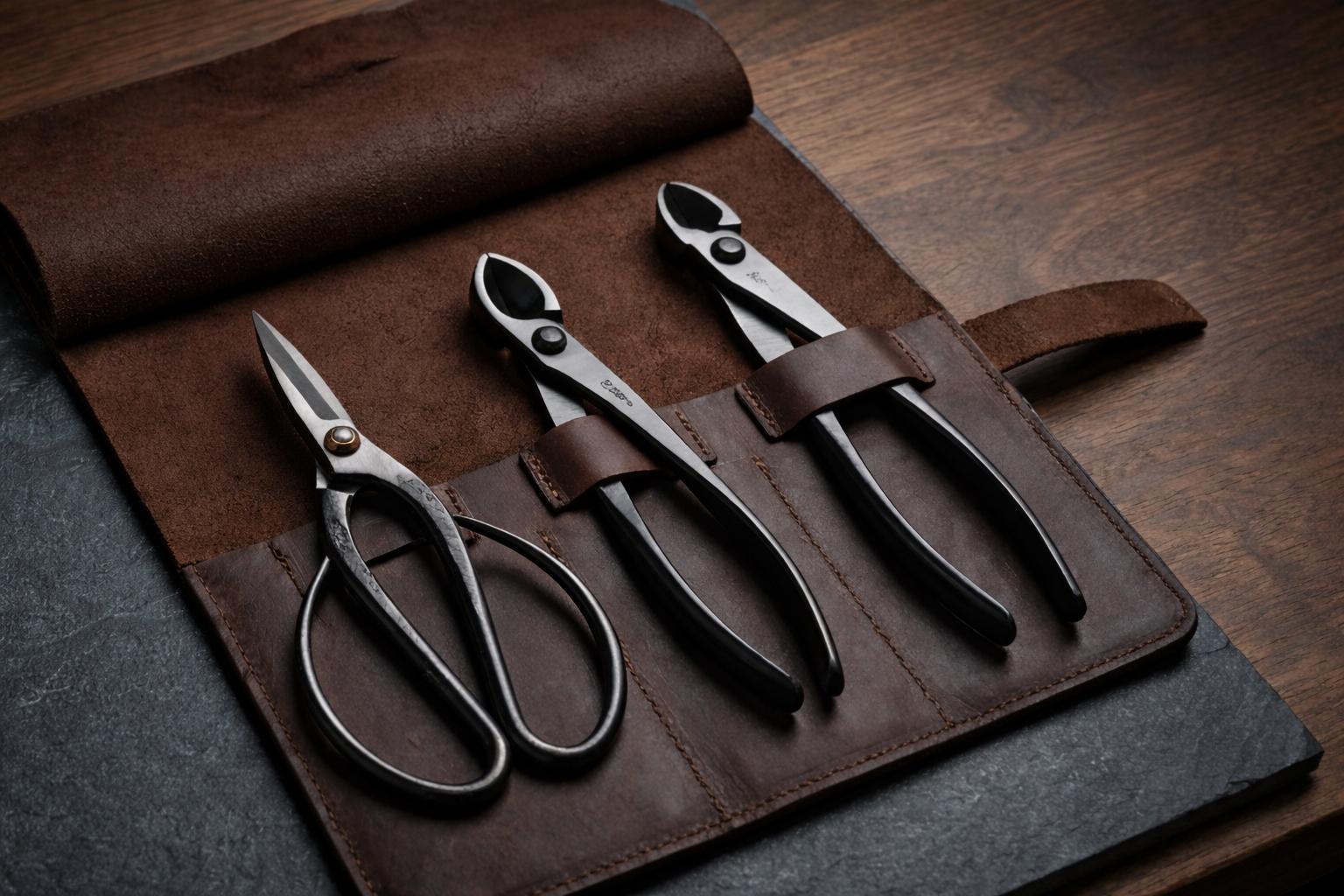
A clean cut surface is essential for rapid callus formation. The callus — the scar tissue — is the cornerstone of the plant’s defense mechanism, sealing the wound against pathogens and restoring nutrient transport. Professional Japanese tools, such as scissors made from Yasugi steel, possess a sharpness that allows cutting between cells, minimizing the number of crushed cells.
This precision means the tree is able to initiate the healing process much more quickly, reducing the risk of fungal and bacterial infections that can easily enter the plant’s vascular system through open, crushed wounds.
One of the most important tools in cutting technology is the concave branch cutter, whose design specifically serves bonsai-specific wound healing. The essence of a concave cut is that the cut surface dips slightly below the plane of the trunk. This approach accounts for the fact that callus bulges outward as it develops. If a branch is removed with a standard garden pair of scissors, the resulting scar forms a visible bump on the trunk, which detracts from the overall aesthetic and disrupts the tree’s natural line. The depression created by Japanese concave cutters and knob cutters provides space for the developing scar tissue, so that by the time healing is complete, the surface becomes entirely smooth and flush with the plane of the trunk.
| Tool type | Cutting characteristic | Physiological effect | Aesthetic result |
|---|---|---|---|
| Mass-produced garden scissors | Crushing pressure, splintered surface | Slow healing, high infection risk | Bumpy, irregular scar formation |
| Japanese concave branch cutter | Clean, recessed cut | Rapid callus formation, closed tissue | Smooth, healed surface flush with the trunk |
| Professional knob cutter | Spherical recess | Maximum tissue protection at nodes | Nearly invisible wound healing |
The Difference Between Japanese Steel and Mass-Produced Alloys
The price and performance of bonsai tools are determined primarily by the quality of the steel used as raw material and the heat treatment process. Japanese manufacturers such as Masakuni, Kaneshin, and Kikuwa apply centuries-old forging traditions that trace their origins to the technology of samurai sword-making. The tools available on the market fall into two main categories: carbon steel and stainless steel, though even within these categories, enormous differences in quality exist.
Carbon steel is the preferred material of serious bonsai practitioners, as it can achieve exceptional sharpness and has excellent edge retention. The Yasugi steels used in Japanese metallurgy (Shirogami — white paper, Aogami — blue paper) have extremely high carbon content, often 1.0–1.4%, which allows hardness levels of 60–65 HRC (Rockwell C) to be achieved. This hardness ensures the tool retains its edge for a long time even when cutting hard species of wood. However, carbon steel is prone to rusting, and therefore requires regular maintenance, cleaning, and oiling.
Stainless steel tools have gained popularity due to their lower maintenance requirements. These tools contain at least 10.5–15% chromium, which forms an oxide layer on the surface, protecting the metal from corrosion. Although modern, high-quality Japanese stainless steels (such as 440C or A8 grades) are now approaching the hardness of carbon steel, they are more difficult to sharpen and their edge angle rarely achieves the microscopic refinement of carbon steel.
Low-cost tools, by contrast, are frequently made from “alloyed steel” or low-carbon iron that has not been subjected to proper hardening procedures. These materials are inconsistent and often contain impurities (phosphorus, sulfur) that compromise the structural stability of the metal. The edge of such tools is lost almost immediately, and the blades may bend under mechanical stress or shatter due to poor heat treatment.
| Steel type | Typical composition | Hardness (HRC) | Advantages | Disadvantages |
|---|---|---|---|---|
| Yasugi White Steel #1 | 1.25–1.35% C | 63–65 | Razor sharp, easy to sharpen | Rusts very quickly |
| Yasugi Blue Steel #2 | 1.05–1.15% C + Cr, W | 61–63 | Excellent wear resistance, lasting edge | Harder to sharpen |
| SK5 Carbon Steel | ~0.85% C | 60–62 | Affordable professional quality | More brittle than Yasugi |
| Stainless (professional) | Cr > 13%, C > 0.6% | 55–60 | Rust-resistant, hygienic | More expensive, harder to sharpen |
| Low-cost alloy | Unknown / Scrap | < 50 | Very cheap | Dulls quickly, damages the tree |
The metallurgical differences manifest not only in sharpness but also in the lifespan of the tool. A quality Japanese instrument may be constructed using laminated technology, where a hard steel core is embedded within softer, more flexible steel. This construction prevents the tool from breaking while ensuring cutting performance. Cheap tools, by contrast, are stamped or cast from a single piece of often poor-quality metal, resulting in use that is unsustainable in the long term.
Manufacturing Centers and Traditions: Sanjo, Sakai, and the Artisan Heritage
In Japan, tool-making evolved in geographically distinct centers where knowledge is passed down from generation to generation. The two most important regions are Sanjo and Sakai, whose names serve as a guarantee of quality.
The city of Sanjo (Niigata Prefecture) is one of the most important global centers of metalworking and the art of forging. The traditions date back to the early 17th century, when local farmers began producing nails and agricultural tools during the winter months as a means of survival. Today, Sanjo has become the stronghold of professional horticultural tools. Most Japanese bonsai tools are made here, including products from the renowned Kikuwa brand. The hallmark of Sanjo manufacturing is a “craftsman-factory” symbiosis: while modern machinery is used for pre-forming, the critical steps — such as sharpening, fitting, and fine-tuning — are carried out by experienced masters. The production of a single tool requires 50 to 60 separate processes, in which the precision of the human eye and hand is irreplaceable.
The city of Sakai (Osaka Prefecture), by contrast, is famous for the production of samurai swords and professional kitchen knives. Tools made in Sakai, such as those of the Sasuke brand, represent the highest aesthetic and functional quality. In this region, the division of labor is highly specialized: separate masters handle the forging, sharpening, and handle fitting. Sakai bonsai scissors are often made from laminated Yasugi steel and are given an edge of such fineness that they are suited to the most delicate plant material — for instance, the precision pruning of Satsuki azaleas.
In contrast to mass-produced Chinese tools (such as the anonymous sets sold on TEMU or Amazon), the origin and quality of steel in Japanese tools can be verified. While Chinese manufacturing is rife with the “white label” phenomenon — where the same low-quality product is sold under various brand names — Japanese tools are backed by renowned workshops and master craftsmen who guarantee the product’s performance with their own name.
A critical part of the manufacturing process is the pivot joint. The connection between the two blades of a high-quality Japanese pair of scissors is so precise that the blades make contact along their full length without binding. In cheap tools, the riveting is often imprecise, which can create a gap between the blades, causing the scissors not to cut but to “fold” plant fibers — leading to severe tissue damage.
Tool Care:
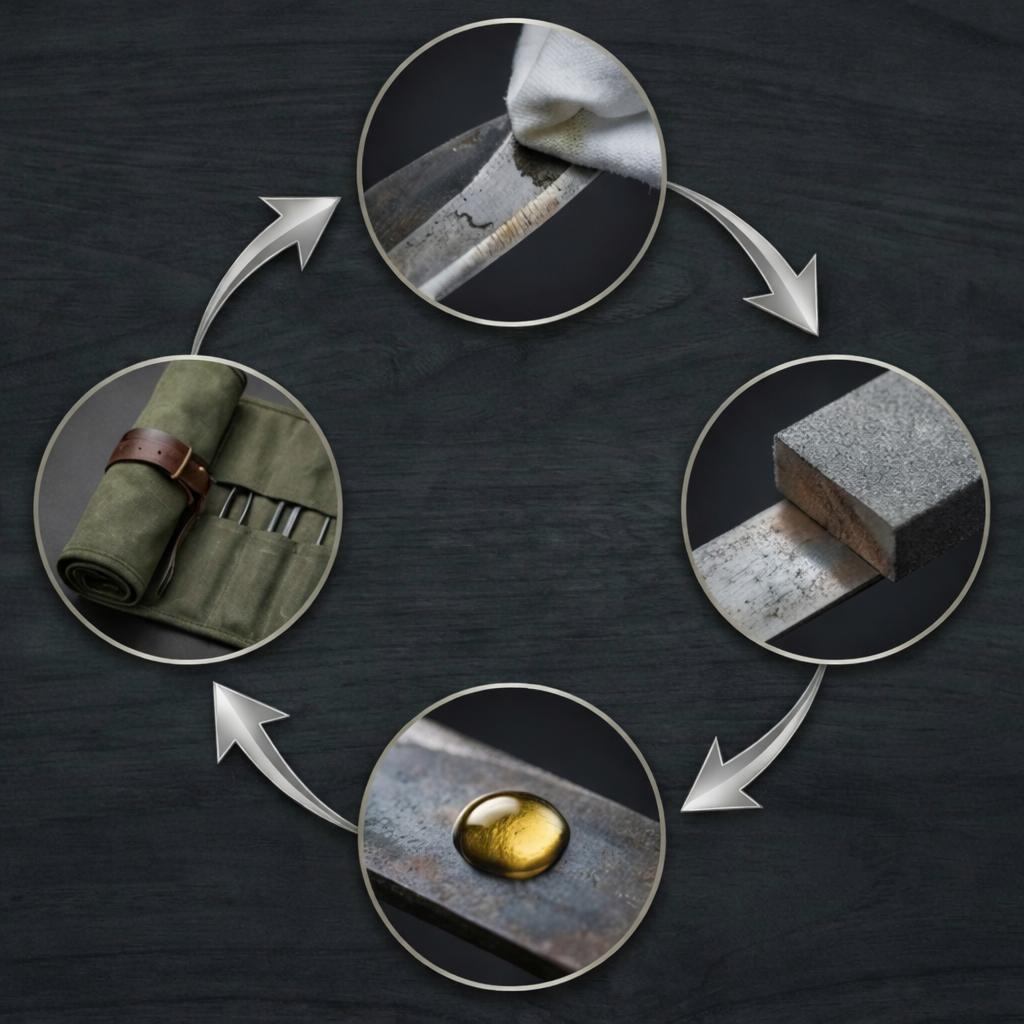
The essence of the “bonsai 5-minute ritual” is not complicated — it is a mindful, consistent habit that makes an enormous difference over the long term to the condition of your tools and the quality of your work.
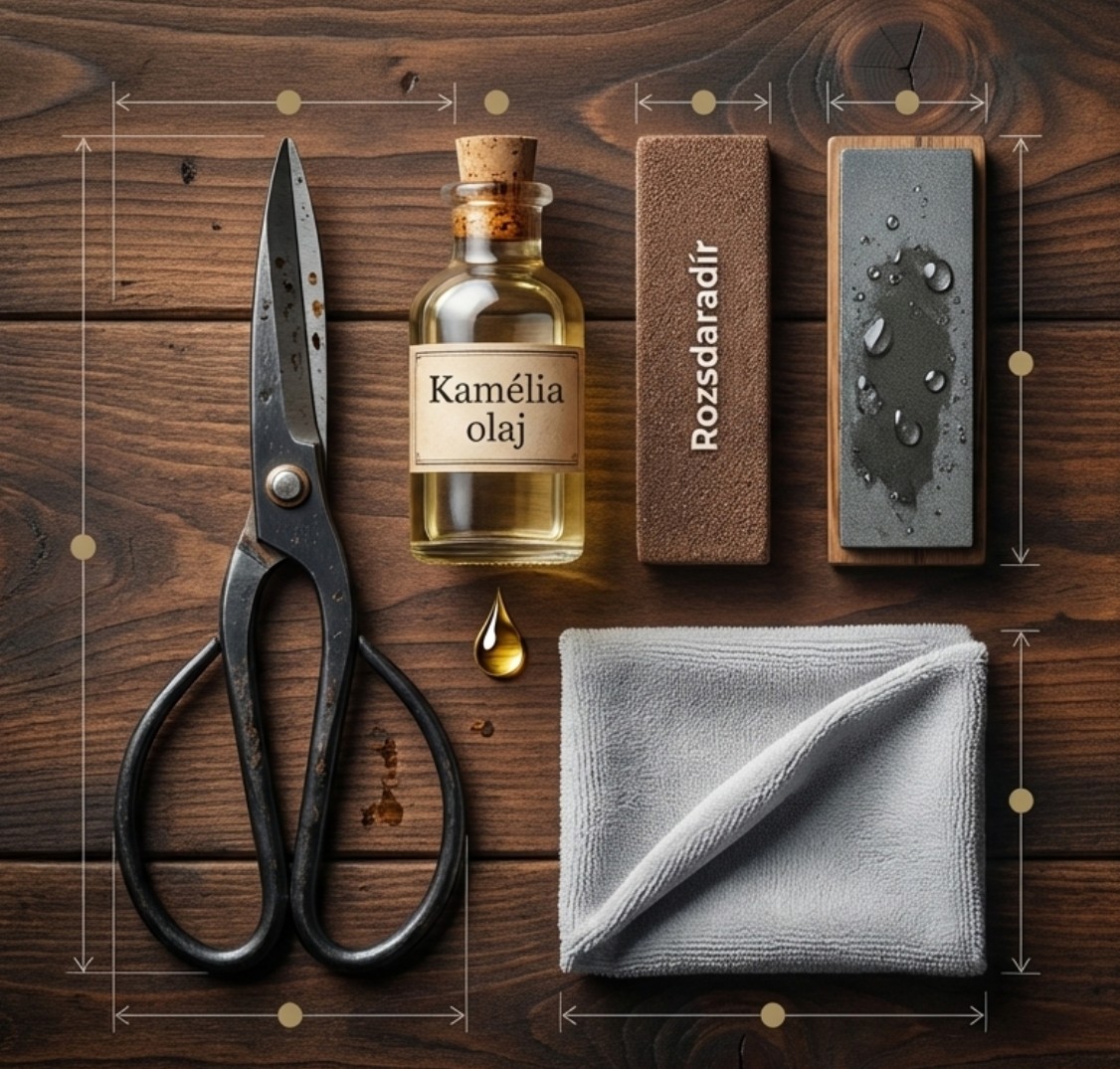
When you finish pruning, don’t set the tools aside immediately. First, wipe away moisture, resin, and dirt with a soft cloth. This is not merely about aesthetics: plant sap can be acidic and will, over time, begin to corrode the metal.
Then, if needed, gently draw the edges across a whetstone. There is no need to think of this as a major sharpening session each time — rather, it is a light “maintenance pass” that preserves the clean, precise cutting action of the blade.
Apply a thin layer of oil. A single drop is enough: spread it gently over the metal surface. This protects the tool from rust, especially if you work or store them in a humid environment.
Finally, return the tools to their holder — ideally a fabric or leather case where they will not knock against each other and will not be exposed to unnecessary moisture.
The Physics of Watering: Negishi Watering Cans and the Protection of Soil Structure
Although in bonsai care the emphasis is often placed on cutting tools, the technical background of watering is at least as decisive for the health of the tree. Watering is not merely the delivery of water; this process is also responsible for the oxygenation of the soil and the maintenance of microbiological balance. Bonsai are cultivated in specialized, granular soil mixes (e.g. akadama, pumice, lava rock) that ensure excellent drainage and the air space necessary for the roots.
An inadequate watering tool — such as a plastic can with large holes or a garden hose — causes physical damage with its coarse jet of water:
- Soil erosion: A high-pressure jet washes fine soil particles out of the pot, leading to the desiccation of hair roots and the loss of stability in the root ball.
- Structural compaction: The weight and impact energy of the water closes the pores between soil particles. This creates an oxygen-depleted (anaerobic) condition, leading to suffocation of fine roots and, within a short time, root rot.
Professional Japanese watering cans, such as those made by Negishi Industry in Tokyo, replicate the effect of “gentle rain.” These handcrafted copper or brass cans feature precision watering roses whose hole size and arrangement ensure that water droplets are small and reach the soil at low velocity.
Among the special features of Negishi cans:
- Long neck: The long, ergonomically designed neck allows hair-precise control of the depth and direction of watering, minimizing physical strain on the user.
- Effect of copper ions: Copper has natural antimicrobial properties. Copper ions dissolved into the watering water help prevent the growth of harmful bacteria in the water, stimulate plant growth, and encourage moss growth that enhances ornamental value.
- Built-in filtration system: A fine metal mesh placed at the fill opening prevents leaves or debris from entering the can, which could clog the microscopically fine holes.
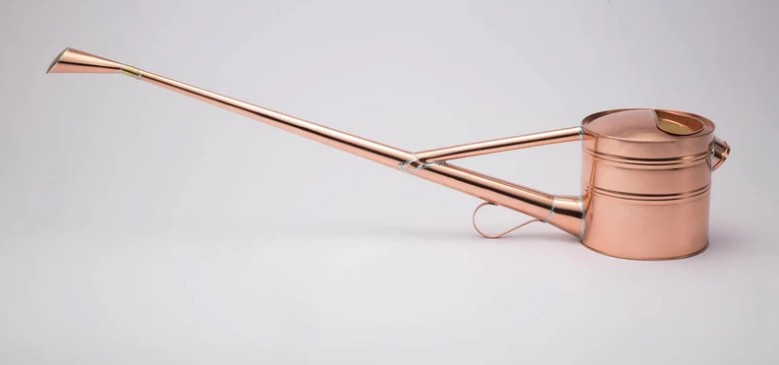
The manufacturing process of Negishi cans is extremely labor-intensive: the soldering is done by hand, often with solder melted over traditional charcoal. Making a single can takes nearly half a day, and only a handful of masters in the world possess the expertise required. This explains the price of $150–200 and above, which however guarantees a tool that will serve its owner for decades — even across generations.
The Economics: A One-Time Investment vs. Ongoing Waste
Although a price tag in the range of 30,000 HUF can seem daunting, it is worth calculating the total lifecycle cost. A quality Japanese tool (e.g. Kaneshin or Masakuni), with proper maintenance, will serve you for 30–50 years. A cheap tool needs to be replaced every 1–2 years, as its material wears down rapidly during sharpening. The destruction of a valuable bonsai tree that has been cultivated for decades — caused by a poor-quality, contaminated, or damaging tool — represents a financial loss that far exceeds the cost of a professional instrument.
Summary
Of course, for beginners it is perfectly reasonable to start with more affordable tools. As a starting point, a single high-quality concave branch cutter and a sharp pair of scissors is sufficient, and the collection can be expanded gradually. Over time, a commitment to the art of bonsai will inevitably lead toward the use of quality tools. Professional Japanese instruments represent a biological and technical necessity for the health of the tree. Razor-sharp, hard carbon steel blades minimize cambium trauma, ensure rapid and aesthetically pleasing wound healing, and protect the plant from the entry of pathogens.
The use of precision watering cans is fundamental to maintaining the integrity of the soil structure, preventing root suffocation and erosion. While mass-produced tools costing around 1,500 HUF may seem attractive due to their low price, they are economically unsustainable in the long run, endanger the lives of trees, and cause physical strain on the user.
The use of tools crafted by artisan masters from the Sanjo and Sakai regions is not merely a technical decision, but also an expression of respect for bonsai as a living art form.
A Guide To The Steels Used In Our Bonsai Tools Chinese vs Japanese Bonsai Tools - Worth The Extra Cost?
A basic guide to bonsai tool selection; what you really need.
Negishi Industry Co. – Watering Cans
A Guide to Buying Bonsai Tools
Essential Bonsai Tools for Beginners and How to Use Them
A Guide To The Steels Used In Our Bonsai Tools
A Guide to Buying Bonsai Tools
Black Carbon vs Stainless Steel
Bonsai Tools Unleashed: Stainless Steel vs. Carbon Steel - Which is Best?