Verticillium Wilt of Japanese Maple
Everything worth knowing about verticillium wilt disease
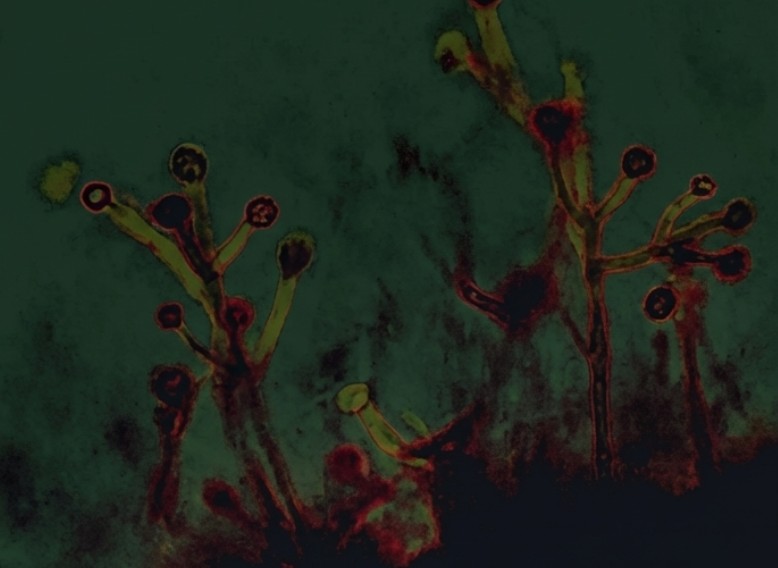
The Japanese maple (Acer palmatum) is one of the most defining elements of temperate ornamental horticulture, with its aesthetic value, delicate foliage, and varied autumn color attracting worldwide attention from landscape architects and hobby gardeners alike. Yet the survival of this prized tree species is threatened by one of the most serious biotic risk factors: verticillium wilt. This disease, caused primarily by Verticillium dahliae and, to a lesser extent, Verticillium albo-atrum, results in the blockage of vascular bundles and the collapse of water transport, frequently leading to the death of the plant. It causes harm in two ways: it physically blocks the passage of water, and it produces toxins. Together, these effects mean the tree literally “dies of thirst,” even when the soil is moist. Verticillium wilt is not merely a local problem; it is a globally widespread pathological process affecting more than 300 host plants, causing significant economic and ecological losses everywhere from nursery production to the management of urban parks.
Symptoms: when the signs become visible — but it’s already too late
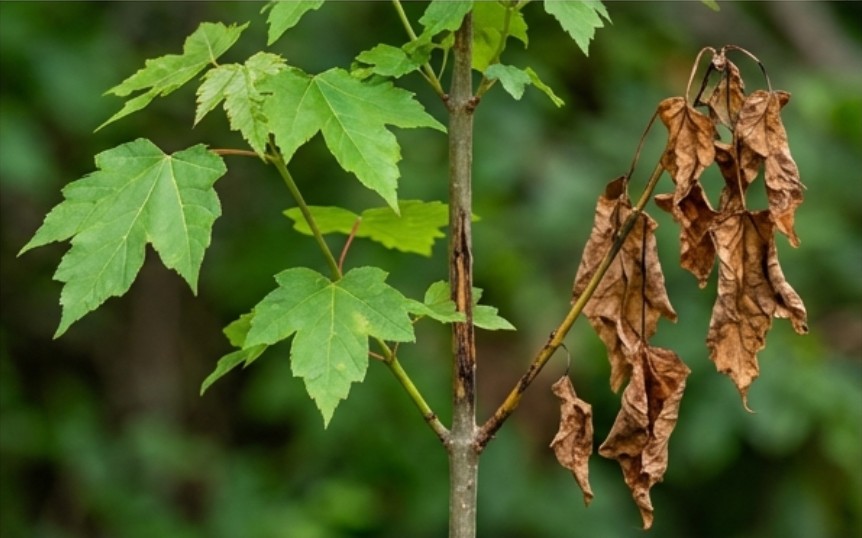
Verticillium wilt is insidious because it can present in two distinct forms. Acute infection is almost shocking. Often during summer heat, an entire branch — or even part of the canopy — suddenly wilts and then turns brown. The leaves frequently do not fall but remain dry on the branch. This phenomenon is known as “flagging.”
The chronic form, by contrast, is slow and deceptive. Growth slows, leaves become smaller and paler, and the tree seems to “overcompensate,” producing an abnormally large crop of seeds. This is a classic sign of stress.
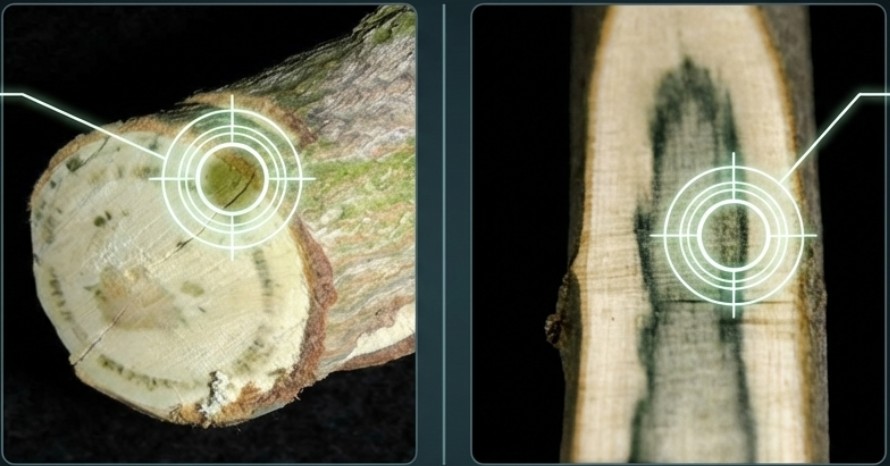
The most telling sign, however, is not visible on the outside but hidden beneath the bark. If the bark is lightly scratched, olive-green or dark green streaking may appear in the sapwood. In the case of Japanese maple, this is one of the most reliable diagnostic indicators.
Mode of infection and spread
Verticillium is not present everywhere — but where it is, it is extraordinarily persistent. The fungus can remain viable in the soil for extended periods through tiny, highly resistant structures called microsclerotia, which enter the soil after infected branches die, causing further infection. These structures are the fungus’s key to survival: they are remarkably resistant to environmental stress, extreme temperatures, and drought. Scientific data indicate that microsclerotia can remain viable in the soil for up to 10–15 years, even without a host plant present. This extraordinary persistence makes the disease virtually impossible to eradicate once it has established itself in a given area. Infection occurs through the roots. The fungus “awakens” when it senses compounds released by the roots, such as sugars and amino acids. Root injuries significantly facilitate entry — whether caused by hoeing, lawn mowing, or even the minor wounds inflicted by soil-dwelling pests.
The infection process and the physiological background of pathogenesis
The critical point of infection is the fungus’s entry into plant tissue. Although Verticillium is capable of directly penetrating healthy root hairs and cortex cells, the process is greatly facilitated by various types of injury. Mechanical wounds caused during mowing, hoeing, or planting, as well as feeding damage from soil-dwelling pests such as plant-parasitic nematodes (Pratylenchus spp.), represent an open gateway for the pathogen. Passing through the tissue layers of the root, the fungus reaches the vessels of the xylem (vascular tissue). Within the xylem, the fungus switches to systemic spread: it produces conidia that are passively transported upward toward the canopy by the water taken up by the plant. This mechanism explains the “sudden” nature of the disease, when symptoms first appear far from soil level — at the tips of branches or on one side of the canopy.
The pathogenesis process is complex: the symptoms are not caused solely by the physical presence of fungal hyphae. The pathogen produces various extracellular enzymes (e.g., pectinases, cellulases) and phytotoxins. These compounds break down cell walls and disrupt the plant’s metabolism. As a defense response, the plant attempts to isolate (compartmentalize) the infection. This defensive strategy involves the formation of gum and tyloses, whereby the plant constructs molecular and physical barriers within the water-conducting vessels to halt the spread of spores. Paradoxically, it is precisely this self-defense mechanism that becomes fatal: the blockage of xylem vessels drastically reduces water transport, leading to leaf wilting, desiccation, and ultimately the death of branches.
Diagnosis: on the line between life and death
In the case of Japanese maple, the symptoms of verticillium wilt can be extremely varied, depending on the age and condition of the plant and the intensity of the infection. The literature distinguishes two main forms of presentation: acute and chronic infection.
Acute infection
The acute form typically affects younger specimens or trees subjected to sudden environmental stress. Symptoms often appear in midsummer, during the hottest weeks, when the plant’s transpiration is at its peak.
- The leaves on one or more branches begin to wilt without any prior warning, then rapidly desiccate.
- Flagging: A characteristic symptom in which a clearly defined portion of the canopy dies while the rest appears to remain healthy.
- Leaf retention: Leaves that have died acutely frequently remain on the tree in a browned, dried state rather than falling immediately, indicating a drastic and rapid cessation of water transport.
- Collapse: In severe cases, the entire plant can dry out completely within a few weeks.
Chronic infection
The chronic form is a more protracted process, in which a kind of dynamic equilibrium develops between the plant and the fungus.
- Slowed growth: Shoots remain shorter, and the thickening of woody parts falls below expectations.
- Microphylly: Leaves may be considerably smaller than usual, yellowed (chlorotic), with scorching symptoms along their margins.
- Abnormal seed production: Under stress, the tree may produce a massive quantity of fruit (paired winged seeds) as a “flight response,” redirecting its energy from vegetative growth to reproduction.
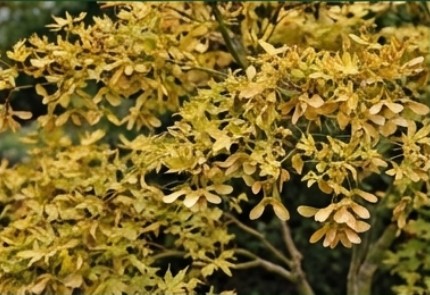
- Dieback: The tips of branches die back progressively, the canopy thins, and the tree’s vitality declines year by year.
The correlation between environmental stress and susceptibility
Japanese maple is fundamentally a demanding plant, accustomed to mild winters and balanced rainfall. Any factor that deviates from its optimal requirements causes stress, which weakens the plant’s defenses. Soil condition is decisive: in compacted, poorly aerated soil, roots suffocate and cells die, creating an ideal entry point for Verticillium. Similarly, waterlogging (e.g., in poorly drained clay soils) causes root death, which amplifies wilting symptoms. During drought, the negative pressure that develops in the xylem facilitates the passive spread of spores toward the canopy, while the tree is unable to devote sufficient energy to building its defensive barriers.
Pruning does not cure the plant
It is important to clarify that cutting out infected branches does not remove the fungus from the plant as a whole, since infection originates from the roots. The fungus lives in the water-conducting tissue (xylem), where it impedes the flow of water and nutrients and produces toxins. For this reason, pruning alone cannot be considered a curative procedure.
Why infected branches should still be removed
Although the plant is systemically infected, pruning serves several important purposes:
- Reducing the source of infection: The fungus forms the microsclerotia that ensure its survival in dead plant material. By removing and burning these branches (not composting them!), we prevent the fungus from returning to the soil and establishing further infection foci.
- Preventing secondary infections: Dead or weakened branches can easily fall prey to other pests or fungi (e.g., canker-causing fungi) that would further deteriorate the tree’s condition.
- Aesthetic and vitality considerations: Removing dead portions improves the tree’s appearance and can help the plant direct its energy toward maintaining healthy parts and compartmentalizing the infection.
The plant’s attempt at self-healing
Japanese maple is capable of attempting to “wall off” the fungus within the trunk or branches by constructing physical and chemical barriers. If the tree is in good condition (receiving adequate water and nutrients), this defense mechanism can be successful, and symptoms may disappear for years at a time (remission), even if the fungus is technically still present within the plant.
Resistance and the dilemmas of cultivar selection
Not every plant is susceptible. Although Verticillium can infect more than 300 plant species, many are completely immune. Japanese maple, unfortunately, is sensitive to it.
| Plant species/Cultivar | Resistance level | Notes |
|---|---|---|
| All conifers | Immune | Never become infected |
| Birch (Betula) | Highly resistant | Excellent substitute |
| Acer palmatum | Highly susceptible | Especially ‘Sango Kaku’ |
| Acer palmatum ‘Bloodgood’ | Disputed | Often sold as resistant, but can become infected |
| Red maple (Acer rubrum) | Moderately resistant | Better survival odds |
| Norway maple (Acer platanoides) ‘Jade Glen’ | Tolerant | Shows few symptoms |
Soil and environment: the hidden risk
One of the greatest challenges of verticillium wilt is that the problem often lies not in the tree but in the soil — quite literally.
If an infected tree dies, a new maple should not be planted in its place immediately. The soil can remain infectious for many years. In such cases, specialist solutions such as soil solarization or biofumigation may be considered.
An interesting observation is that trees planted in open ground become infected more frequently than containerized or bonsai specimens. The reason is simple: garden soil is potentially contaminated, whereas the growing medium in containers is generally controlled and clean. However, in the absence of regular sterilization, should the pathogen enter our garden, containerized plants can also become infected in turn.
Closing thoughts
The fight against verticillium wilt is not about victory — it is about balance.
Since there is no true cure, the goal is to maintain the tree’s vitality. Consistent watering, balanced nutrition, soil protection, and precise hygiene all serve the same purpose: enabling the tree to keep the pathogen living within it under control.
This is a form of coexistence — tense, but not without hope.
Addendum: nursery growing of bonsai stock material
Due to nursery practices and the methods used to grow Japanese maples, this disease poses a serious risk — but with certain precautions, the situation can be managed. Verticillium wilt is a soil-borne fungus that infects most readily through wounds inflicted on the roots.
In a nursery environment, you must be especially vigilant for the following reasons.
Why does this pose such a great threat in nursery stock growing?
During root culturing, the lifting of plants and cutting back of thicker roots inevitably causes mechanical injuries. These fresh wounds represent ideal infection gateways for pathogens present in the soil. If verticillium is present in the soil, then every such intervention is a potential infection event.
The risk is further compounded by the fact that in nursery work, infection can spread not only from the soil but also during the handling process itself. After cutting the root of an infected plant, if the same tool is used to continue working, the pathogen can be directly transferred to the next, previously healthy specimen. In this scenario, infection no longer occurs randomly but becomes systemic.
Added to this is the physical movement of soil. During lifting, replanting, or even just walking around during work, infected soil particles can easily be displaced to other parts of the nursery. Traveling on boot soles, on spades, or on machinery, the pathogen spreads unnoticed.
All of this is compounded by the fungus’s extraordinary survival capacity: its microsclerotia can remain infectious in the soil for up to 10–15 years, even in the absence of a host plant.
Hygiene as a system, not a gesture
In this environment, strict hygiene is a condition of survival. This is not about occasional, one-off disinfection but about a consistently maintained system.
Sterilizing tools after each individual plant is essential, but during root pruning an even stricter discipline is warranted: sterilization may be necessary between individual cuts. Physical cleanliness is equally important. Cleaning tools, footwear, and equipment before leaving a contaminated area is not meticulous overkill — it is one of the primary barriers to the spread of infection.
Managing infected individuals: the weight of decisions
In a nursery, it is a particularly difficult question to know what to do with infected plants. Whereas in a garden, emotional attachment often tips the balance toward keeping a tree, in a production environment the protection of the entire stock takes priority.
Severely infected specimens are best removed in their entirety, roots and all. These plants are a problem not only for themselves but function as a continuous source of infection. The method of disposal is also not a trivial matter: composting is not appropriate, as the pathogen survives this process. Burning or removal off-site is the only safe course of action.
Summary
Root culturing is not the enemy of Japanese maple — but in the presence of verticillium, it can easily become one. The difference lies not in the technique itself but in how it is carried out. In nursery growing, it is essential to establish a strict, consistent system. Hygiene, mindful soil management, and continuous monitoring of plant condition together form the protective net capable of keeping this invisible yet extraordinarily tenacious enemy in check.
Verticillium Wilt of Ornamental Trees and Shrubs - CT.gov
Verticillium Wilt Japanese Maple - Strobert Tree Services
Verticillium Wilt of Landscape Trees Arboriculture & Urban Forestry
Verticillium Wilt of Landscape Trees and Shrubs - Ohio Woodland Stewards Program
Verticillium Wilt: Prevention & Care RHS Advice
Verticillium wilt refresher - MSU Extension
Maple (Acer spp.)-Verticillium Wilt Pacific Northwest Pest Management Handbooks
Comparative Assessment of Verticillium dahliae Tolerance in 77 Olive Cultivars - MDPI
Verticillium Wilt - Cornell Cooperative Extension Nassau County
Wilt Threatens Japanese Maples
(PDF) Biological Control of Tomato Verticillium Wilt by Using Indigenous Trichoderma spp.