The Simplest Bonsai Task That Takes Three Years to Learn!
In the world of Japanese bonsai, masters say it takes three years to learn how to water correctly. Anyone who hears this for the first time usually thinks the same thing: how complicated can it be? Pouring water from a can into a pot doesn’t seem like much of a science. Which is precisely why it comes as such a shock to discover that bonsai masters consider this one of the most difficult things in the entire art form.
Watering is not a technique. It is observation.
A bonsai master is, in fact, making a diagnosis every single day. They observe the tree, the soil, and the environment, then decide whether water is needed at all. But let us walk through the fundamental principles that help in mastering watering — not every bonsai enthusiast can spend years alongside a Japanese master.
The Three Essential Questions
Before watering, the bonsai caretaker should always pause for a moment and consider three fundamental factors.
The first is the tree itself. How many leaves or needles does it carry? Foliage mass is the primary determinant of water consumption. Approximately 85% of the water taken up by the tree evaporates through the leaves, simply to cool the plant — much the same way the human body cools itself through perspiration. The greater the foliage or needle mass, the faster the tree depletes its available water supply.
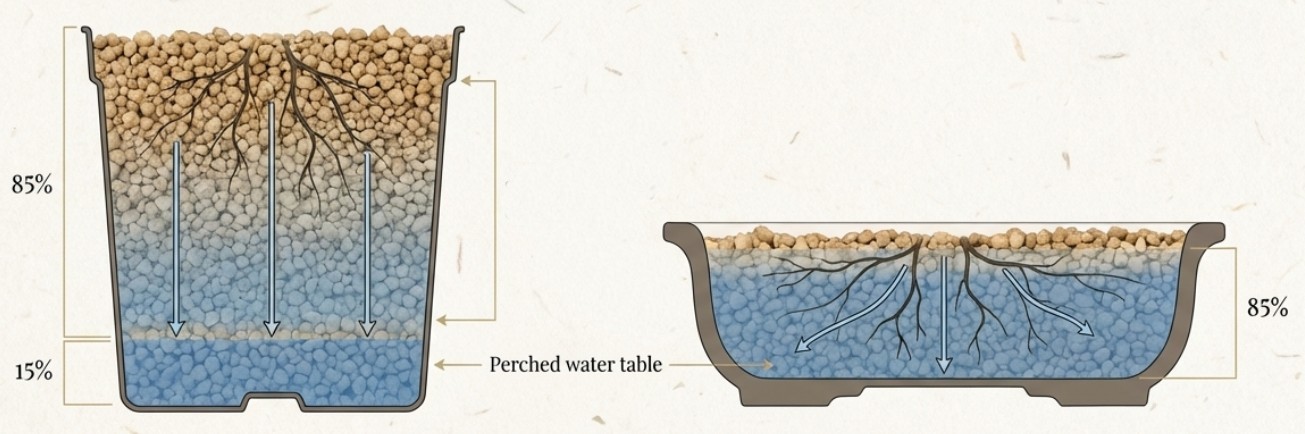
The second factor is the pot, meaning the water-holding medium. A tree with a large canopy in a small pot will dry out far more quickly than the same canopy in a larger container. One must always consider how much moisture the soil volume can hold, and what level of water demand the tree’s foliage places against it. Many people assume that deeper pots retain water longer, but the reality is quite the opposite: water generally passes through a deeper pot more quickly, while shallower pots tend to retain moisture for longer periods.
The third factor is the environment. Temperature, the intensity of sunlight, wind, and air humidity all directly influence the rate of transpiration. On a hot, sunny, windy day, the tree needs to be watered far more frequently than on a cool, overcast one.
These three factors — the tree, the pot, and the environment — form the basis of every watering decision. If the bonsai caretaker consistently takes them into account, they will gradually develop the kind of intuition that helps them recognise when the tree truly needs water, and when it is better to wait a little longer.
Watering Is Actually a Diagnosis
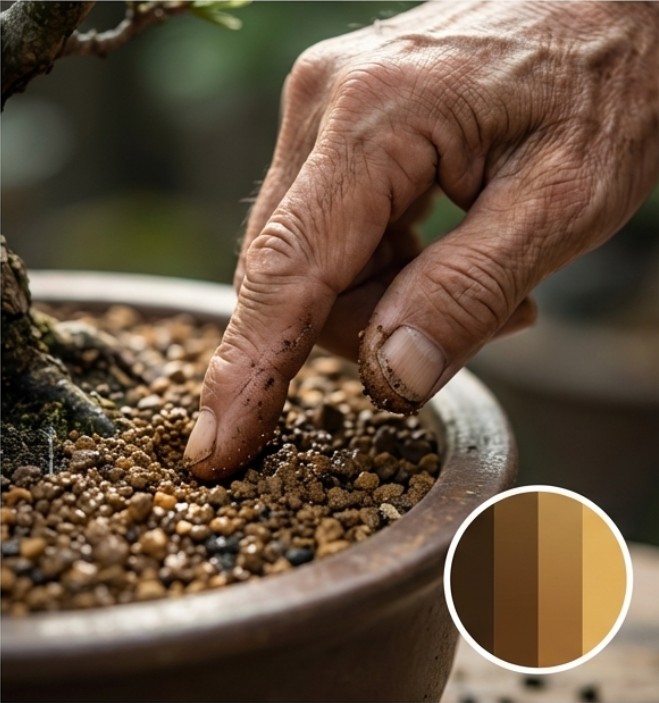
Japanese masters do not teach their students how many times a day to water. On the contrary — they teach them how to determine whether watering is needed at all. As a bonsai caretaker walks through the garden, they continuously observe the moisture content of the surface soil layer and the visible soil particles. Akadama is dark brown when wet, but takes on a light, yellowish hue as it dries — a practised eye can tell from a distance how much water is in the pot.
But that is only the first step.
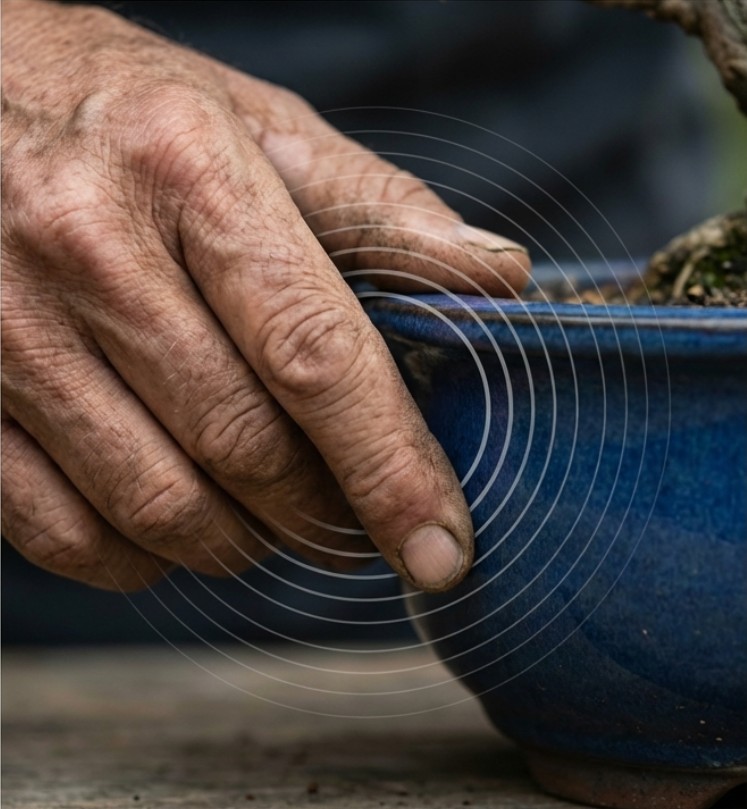
Japanese gardeners will often gently tap the side of the pot. The sound reveals a surprising amount: dry soil produces a clearer, more resonant ring, while water-saturated soil sounds more muted. Some simply lift the tree — when the soil is dry, the pot is noticeably light; when wet, noticeably heavier. And sometimes the simplest method is the best: a finger into the soil, one centimetre deep.
Watering in the Rain?
There is a less obvious but very important factor: a wide, dense canopy can act almost like an umbrella over its own root system in the rain. Leaves and branches intercept a significant amount of rainwater before it ever reaches the soil. In lighter rainfall, it is entirely possible for the surrounding environment to become thoroughly wet while the bonsai’s root ball remains relatively dry. The lesson is straightforward: trees must be checked every single day, regardless of whether it has rained.
The Basics: Water, Tools, and Patience
When someone is first learning to water bonsai, the quality of the water need not be a primary concern. Ordinary tap water provides everything the tree needs at a beginner level. In the long run, however, if it is possible, watering with rainwater is preferable due to its neutral pH. Choosing the right tool also matters. The ideal watering can has a very fine, soft rose that distributes water evenly across the surface of the soil.
How to Water Correctly
When the time comes to water, the goal is for the entire root ball to become evenly and thoroughly saturated.
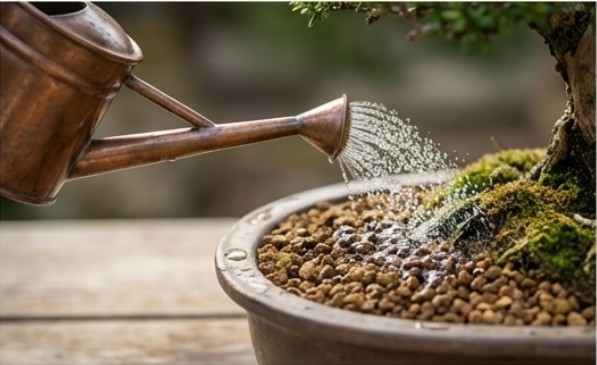
Japanese masters often water in two stages. First, they moisten the soil surface only lightly — this breaks the surface tension. A few minutes later comes the second watering, at which point the water can easily penetrate the entire root ball. The watering can should be kept in constant motion so that water does not concentrate on a single point and disrupt the soil structure. It is important to water from all sides of the pot, not only the part that is most visible from above.
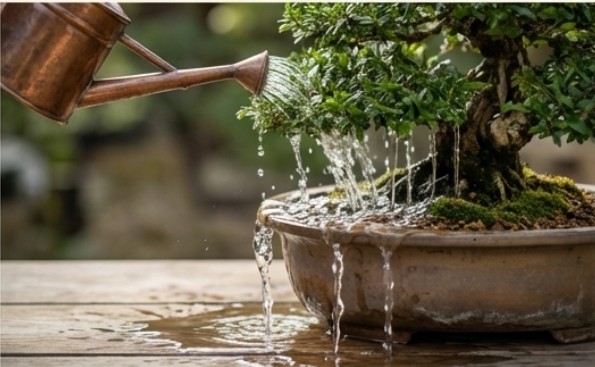
Watering should be carried out in several passes until water begins to drip steadily from the drainage holes at the bottom of the pot. A gentle, continuous trickle from the drainage holes — not a strong flow — indicates that the root system has been adequately saturated.
Where possible, avoid watering the foliage directly. Although this is sometimes unavoidable when branches hang over the soil surface, keeping leaves persistently wet slows the tree’s growth. Leaves function most efficiently when they are dry and actively transpiring.
There is another important rule that students learn quickly. Watering with ice-cold water during summer heat is dangerous because it can cause thermal shock to the plant. When summer sunlight heats the bonsai tray and the soil within it, a sudden flood of ice-cold tap water shocks the delicate feeder roots, which can directly weaken the tree. To equalise the temperature of the water, it is worth leaving watering water to stand in a container until it reaches ambient temperature. This approach not only evens out the temperature difference but also allows chlorine and other chemicals to dissipate, which is particularly important for more sensitive species.
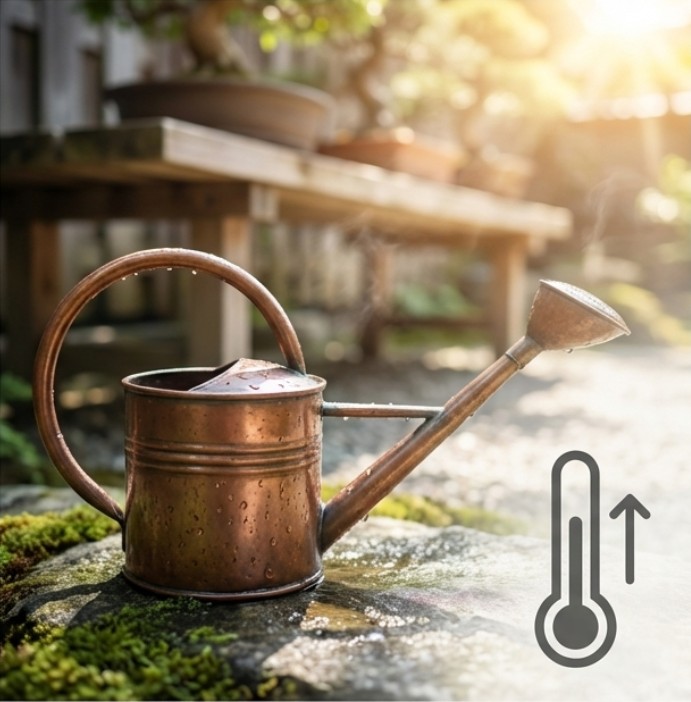
On hot days, it is worth avoiding watering during the hottest hours when the tree is in direct sunlight. If water splashes onto the leaves, the droplets can act as lenses and scorch the foliage. Instead, late afternoon or evening watering is recommended, allowing the soil to remain moist throughout the night.
The Balance Between Water and Oxygen
The fundamental challenge of watering bonsai is not simply providing the tree with enough water — it is maintaining the proper balance between water and oxygen in the root zone. Roots need oxygen to breathe and function correctly. If a pot is regularly overwatered, the soil becomes saturated and an anaerobic condition develops: oxygen is displaced from the soil. In this oxygen-deprived environment, roots quickly begin to rot.
Underwatering, by contrast, presents a far more immediate risk. A single missed watering on a hot day can be enough to kill a tree, whereas overwatering generally causes fatal damage only over several weeks or even months. This asymmetry is important for beginners to understand: a little too much water is generally less dangerous than too little — though neither extreme is desirable, of course. The goal is always to find that ideal state where both moisture and oxygen are present simultaneously in the root system.
The Role of Water in the Tree’s Biology
Understanding the role water plays in the tree’s biology makes it easier to appreciate why proper watering is so important.
Approximately 85% of water exits through the leaves during transpiration — this is the tree’s natural cooling system. This is why a bonsai may need to be watered two or even three times a day in summer. The remaining 15% participates in metabolic processes, the most important of which is photosynthesis. The hydrogen and oxygen atoms of water molecules combine with carbon from carbon dioxide entering through the stomata in the leaves, and through a series of chemical processes are converted into glucose. This glucose is the tree’s fundamental energy source and building material.
In the evening hours, as the tree enters its dark cycle, respiration takes over the primary role. The glucose produced during the day is converted into active energy that drives the creation of new tissues — this may mean the growth of shoot tips, thickening of the trunk, or the formation of new root tips within the pot.
In spring, during the period of bud break, the tree also requires a great deal of water. In winter, however, an entirely different problem arises: the soil may actually freeze. Although the tree is in a dormant state during winter, sap movement does not cease entirely, and the tree cannot take up frozen water. This is known as physiological drought.
Pot Type and Soil Volume
The container in which a tree grows has a significant influence on how it should be watered. A tree in a true bonsai tray — small, shallow, filled with granular, well-draining soil — will dry out far more quickly than the same species in a nursery container with organic soil. The smaller soil volume and faster drainage mean such a tree needs to be checked and watered more frequently.
An interesting example of how different factors interact: two trees of the same species — one in a bonsai tray with little foliage, the other in a nursery container with a much larger canopy — may actually dry out at roughly the same rate. The bonsai tray’s smaller volume and fine soil dry out quickly, but the sparse foliage places only a moderate water demand on it. The nursery container holds more water, but the larger canopy transpires far more intensively. These opposing forces often cancel each other out, so the two trees may end up on a similar watering rhythm, even though they are growing under completely different conditions.
The Bonsai Soil’s Special Component
The foundation of the classic Japanese soil mix is akadama, a granular clay of volcanic origin. When freshly placed in a pot, the particles are hard and porous: water passes through quickly, and the roots receive ample air. In the first year, the tree often dries out rapidly, and the student finds they need to water far more frequently than expected. Then the months pass, and something slowly changes.
With time, the akadama particles begin to break down. The granules become smaller and gradually start to compact. The soil retains more water but allows less air to reach the roots. The same tree, in the same pot, with the same soil — yet behaving in an entirely different way three years later. This is one reason why watering cannot be reduced to simple rules. The bonsai substrate is constantly changing.
The Ageing of Akadama
The ageing and physical breakdown of akadama fundamentally alters the water and air permeability of the bonsai substrate, requiring the gardener to continuously adapt.
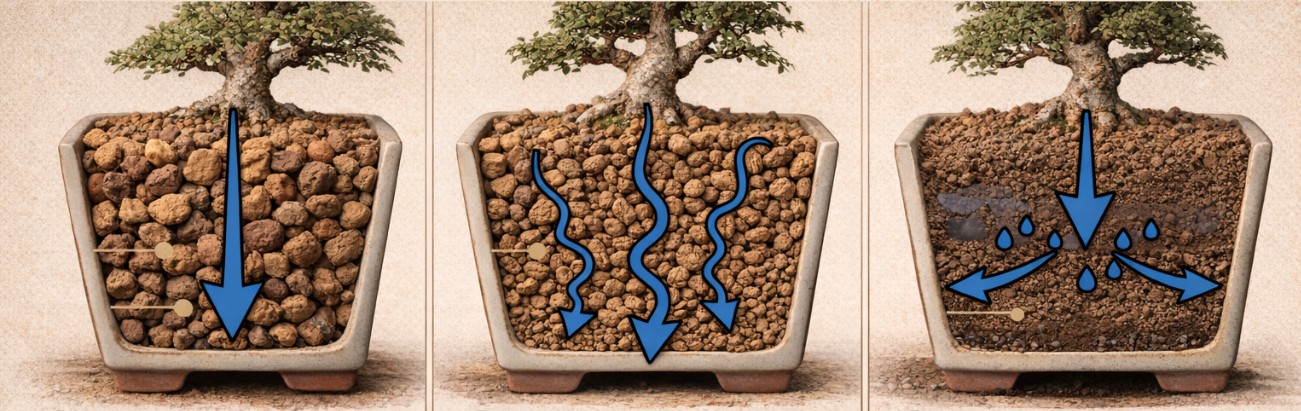
The three-year watering principle refers in part to the need to learn how to manage this changing dynamic over a full cycle. The watering strategy adjusts as follows depending on the condition of the akadama:
The Initial Period (Fresh Akadama)
When the tree has just been potted, the akadama particles are hard, stable, and porous. The soil drains exceptionally well and is superbly aerated — water flows through the large gaps between particles almost immediately. In this phase, more frequent watering is required, as the fresh, free-draining medium stores relatively little water over time.
The Ageing Process (Breakdown)
Akadama is not a material with a permanent structure: under the influence of weathering (freeze-thaw cycles), alternating wetting and drying, and the pressure of growing roots, the particles begin to crumble. The hard clay spheres break down into fine clay dust and small particles, which naturally increases the soil’s water-retention capacity while reducing aeration.
The Late Stage (After Year 3)
After several years — one to two for softer grades, three to five for harder ones — the structure of the soil changes significantly. At the bottom of the tray, the particles consolidate into a fine, silt-like layer that retains far more water but allows almost no air to reach the roots. The gardener must water less frequently, or be more careful with quantities. Watering at the same frequency as in the first year would cause the roots to suffocate and rot in the compacted, airless soil.
The Essence of Adaptation
Masters teach that one cannot water a freshly potted tree the same way as one that has been living in the same medium for three years. With ageing akadama, checking the weight and using the acoustic feedback from tapping the pot become increasingly important, because the surface can be deceptive while the lower, silty layer remains fully saturated. If the water begins to soak in only slowly at the surface due to compaction, a skewer can be gently worked into the soil to create channels for better penetration — but ultimately, the only real solution is refreshing the soil and repotting.
Species-Specific Needs and Heat Sensitivity
A bonsai master knows that every species has different water requirements, and breathes differently. The water needs of different tree species can vary considerably, and watering technique must always be tailored to the individual tree.
To understand this, it helps to take a step back: a tree’s native elevation and climate directly influence its relationship with moisture. The hinoki cypress, for example, originates from Japanese mountain forests, where a dense canopy creates a cool, consistently humid understorey. In bonsai conditions, this means its roots must be protected from direct sunlight at the height of summer heat, and the soil kept relatively consistently moist. The Japanese white pine, by contrast, comes from higher-altitude, dry, windswept terrain — this species requires restrained watering, and roots can quickly rot in persistently wet conditions.
It is important to note, however, that a species’ origins are only a starting point, not an immutable rule. The one-seed juniper comes from the near-desert highlands of New Mexico — yet in a warm, humid climate its growth accelerates noticeably when watering is adjusted accordingly. The lesson: evolutionary background is a guide, not a constraint.
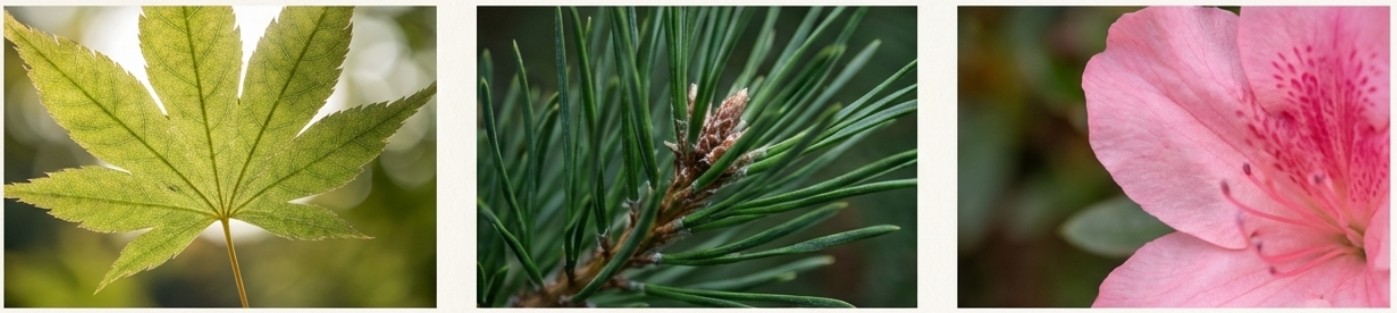
Deciduous trees have thin leaves and a very thin cuticle (the waxy layer that slows water loss), meaning they transpire far more rapidly than conifers. They therefore need to be watered more frequently, particularly in warm weather — the thin leaves of Japanese maples will scorch almost immediately when water is scarce. They need a consistently moist but never waterlogged medium.
Conifers (pines, junipers) generally tolerate a slightly drier root zone and can go somewhat longer between waterings. Controlled water reduction — a degree of controlled stress — can help achieve shorter, more compact needle growth. Yet their very drought tolerance makes them easy to overwater, particularly when they are still in large nursery containers with organic soil rather than a bonsai tray with a granular mix.
Azaleas have extremely sensitive feeder roots. They require acidic kanuma soil, and the root crown beneath the trunk must never be allowed to dry out.
Temperature is also an important factor. Most trees function best at around 30°C, as this is the optimal range for photosynthesis. When temperatures climb into the 32–35°C range, the tree devotes increasing energy to cooling itself and progressively less to growth. For heat-sensitive species — mountain species, thin-leaved trees — it can be beneficial to move them into partial shade during the hottest part of the day. This slows transpiration, reduces water demand, and protects the tree from heat stress.
Developmental Stage and Watering Strategy
Watering approach is shaped not only by species, but also by where the tree is in its development.
In the early development phase — when the goal is building the trunk, establishing appropriate taper, and strengthening the primary branches — trees are typically grown with generous water supply. The soil is kept consistently moist, which encourages vigorous growth. This is a different philosophy from that applied to more refined bonsai: here, what matters is not fine detail, but rapid, healthy material development.
In the refinement phase, the goal is entirely different: slowing growth, reducing foliage size, and perfecting the fine branch structure. For certain coniferous species — such as the Japanese white pine — mild water restriction can help produce shorter needles, lending a more proportional, refined appearance. This must be applied with great caution, however: if water supply is restricted too severely, branches can die back.
For deciduous species, this principle does not apply at all. In maples or elms, withholding water does not reduce leaf size — instead, it causes stress that can ultimately lead to the tree’s death. For these species, the only safe path to smaller leaf size is selecting the appropriate species or cultivar.
When You Are Away from Home for a Few Days
One common challenge for bonsai caretakers is what to do with their trees when they are away for a few days. It is important to understand that a tree kept outdoors — no matter how shaded a spot it is placed in — continues to photosynthesise, responds to environmental conditions, and continuously loses water through its leaves via transpiration. Moving the tree to a shadier location is no substitute for regular watering.
If you are only away for a day or two, the most effective solution is to water the tree thoroughly, then temporarily bring it indoors. Inside, where there is no wind and no direct sunlight, the tree loses water far more slowly, and will generally come through a brief absence without difficulty.
What Does One Actually Learn Over Three Years?
Viewed from the outside, the student does the same thing every day for three years: they water. But in reality, something entirely different is happening. They learn to read the soil. They learn to understand the weather. They learn to notice the most subtle signals from the tree. They learn the rhythm of akadama’s ageing.
Bonsai watering is not a skill one learns once and then applies mechanically. It is far more the result of continuous observation, consideration, and refinement. Each time we approach a tree, we take into account everything we know about it: the species, the container it grows in, the current weather conditions, and when and how thoroughly it was last watered.
Over time, these many small observations consolidate into reliable instinct — the ability to look at a tree and know almost immediately whether it needs water or not. This instinct is the foundation upon which the cultivation of healthy bonsai is built.
Watering in the art of bonsai is a form of meditation. It cannot be rushed, and it cannot be automated. The master does not water mechanically — they are fully present each time: examining the tree’s condition, the strength of the wind, the angle of the sunlight as the seasons change.
Dear reader — since I have not had the opportunity to spend three years studying bonsai watering techniques alongside a Japanese master, this piece has been compiled from my own experience and with the help of online resources. If you would like to read further, please see the sources listed below, and I would especially like to highlight the excellent instructional videos on the Bonsai Mirai YouTube channel. Wishing you every success in mastering the art of proper watering.
How to evaluate bonsai water needs - Bonsai Tonight
How do you tell if bonsai is over or under watered? - by Mariya Kanegi - Medium
How and when do I water my bonsai tree? - NYBG Mertz Library Reference
The Challenges of Caring for Bonsai Trees - by Mariya Kanegi - Medium
Bonsai soil, recommended substrate mixtures
Signs Your Bonsai Soil Needs Replacing - Bonsai2U
A Scientific Analysis for Bonsai Soil - akadama, Pumice, and Lava Rock Compost Mediums & Mixes - South Yorkshire Bonsai Society
Part 2 – Major Soil Components - East Bay Bonsai Society
Soil Matters: Exploring the Foundation of Bonsai Health
Bonsai Mirai
Best Soil for Indoor Bonsai Trees - akadama, Pumice & Lava
Unlocking Soil Secrets: A Guide to akadama Soil for Bonsai
To akadama, or not to akadama? - Bonsai Empire Know When to Water Your Bonsai: 3 Simple Methods
How do you tell if bonsai is over or under watered? - Medium
Bonsai Care and Maintenance
A Beginner’s Guide to Growing Mame Bonsai - Dengarden
Best Way to Water a Bonsai Tree: Proper Techniques Explained
What Are Humidity Trays, And How Do They Help Bonsai Trees? - by Mariya Kanegi
What Do We Do With Bonsai In October? - Michael Hagedorn Bonsai - STORIES - JAPAN HOUSE