The Effect of Wind and Environmental Stress on Japanese Maples
The aesthetic value and morphological fragility of the Japanese maple are closely intertwined, as it evolved in its native habitat as an understory plant in humid, sheltered forests. When placed in a garden environment, however, it frequently faces leaf browning — something most hobby gardeners immediately attribute to direct sunlight. While solar radiation can indeed cause heat stress, professional observations and research suggest that wind, especially hot and desiccating air movement, is physiologically far more destructive than sunlight itself. The reason is that while sunlight primarily causes localized overheating, wind can disrupt the plant’s entire water balance and also inflict mechanical damage on the foliage.
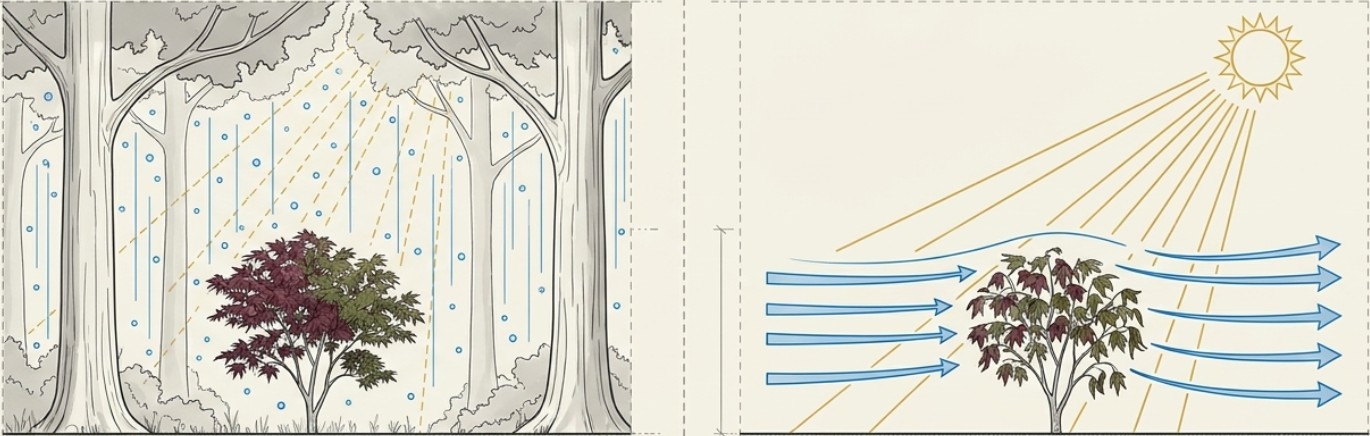
While it evolved as an understory shrub in its native habitat, domestic gardens are characterized by open spaces, drying winds, and continental heat waves — creating a transpirational stress for which the plant is evolutionarily unprepared.
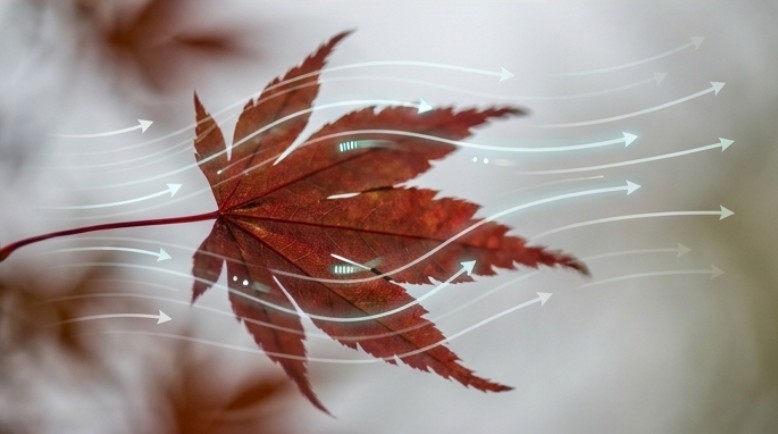
The plant’s physiology in such conditions reflects a dramatic struggle against dehydration. At the center of this process is the so-called boundary layer — a thin, relatively still, and humid layer of air on the leaf surface. This layer acts as a natural protective shield against water loss, but wind effectively “sweeps away” this safety zone, drastically reducing diffusion resistance.
Once this humid microenvironment disappears, the difference in water vapor pressure between the interior of the leaf and the outside atmosphere spikes, leading to forced and uncontrollable transpiration. The Japanese maple then exhibits a kind of “panic response”: the sudden water loss causes turgor pressure within the cells to drop, resulting in the rapid closure of stomata. This is, however, a double-edged sword — while transpiration slows, its cooling effect is also lost, causing leaf temperature to rise further and ultimately leading to secondary scorching.
In more severe cases, tension builds in the water-conducting vessels (xylem) to such a degree that air bubbles block the flow of water, potentially causing the sudden dieback of entire branches.
When diagnosing wind damage, asymmetry is the most telling sign — symptoms are always most severe on the side of the tree exposed to the wind. The most characteristic symptom is marginal necrosis, meaning browning of the leaf edges and tips, as these points are the farthest from the end of the water transport pathway. Wind-scorched leaves become thin and papery, taking on a light brown or grayish hue. Inward curling of the leaves is also a common occurrence, as the plant attempts to reduce its evaporative surface area. Mechanical damage should not be overlooked either: when leaves strike each other or the branches in the wind, the protective wax layer and epidermis are damaged, leaving dark rubbed spots or brown lines on the leaf blade.
The foundation of effective protection is the deliberate design of an appropriate microenvironment. When selecting a planting site, it is worth choosing a sheltered location from the very beginning — such as the east-facing side of a building or the shade of larger evergreen windbreaks. If the garden’s conditions do not allow for natural protection, artificial windbreak netting or screens can be used to slow air movement, which is especially vital for newly planted specimens. The proximity of garden ponds dramatically reduces transpirational stress by increasing local relative humidity.
A thick layer of pine bark mulch applied at soil level — kept away from the trunk — helps keep the root zone cool and moist, preventing sudden desiccation. As a modern solution, anti-transpirant spray products can also be employed, forming an invisible, thin film on the leaves that physically inhibits excessive transpiration during the critical summer weeks. It is important to note, however, that if damage has already occurred, there is no need to panic: do not remove the damaged leaves immediately, as they still provide some shade to the buds, and never begin fertilizing a stressed plant, as fertilizer salts can only further increase tissue dehydration.
Which Japanese maple cultivars tolerate wind best?
Among Japanese maples, the Acer palmatum species type (green maple) and upright-growing cultivars generally show the greatest resistance to wind. These plants have a more robust structure, with thicker leaves and wider lobes, providing them with greater internal water reserves and physical protection against desiccating effects. The leaves of variegated cultivars (e.g., ‘Butterfly’, ‘Ukigumo’) are so delicate and thin that they have virtually no such protection, meaning even the slightest wind can cause immediate scorching. The dissectum group, with their lacy leaf structure, are practically unable to form a boundary layer, making the selection of a wind-sheltered spot essential.
The following cultivars are considered the most resilient:
Acer palmatum (species type): This is the toughest form, relatively fast-growing, and the most broadly tolerant of varied climatic and soil conditions.
‘Bloodgood’: One of the most popular upright red-leafed cultivars, whose robust constitution allows it to better withstand wind and sun than most of its peers.
‘Osakazuki’: An excellent green-leafed cultivar that is considered particularly hardy and tolerates windier locations well.
‘Emperor I’: A vigorous and strong-growing red cultivar that, similarly to ‘Bloodgood’, tolerates environmental stress well.
‘Omure yama’: Another recommended green, upright cultivar with good resilience.
These types are physiologically more resistant because a thicker boundary layer — a protective air layer — can form around their wider leaf blades, slowing transpiration.
It is important to note, however, that even the most resilient cultivars require protection from hot, dry southerly winds, and balanced watering during wind events is crucial to replenish sudden water loss.
Leaf Scorch of Ornamental Trees and Shrubs
What Causes Black or Brown Leaf Scorch & Burn on Japanese Maple Leaves
How to Prevent Leaf Scorch and Environmental Stress in Japanese Maples Herter Nursery
Protect your Japanese Maples - Alden Lane Nursery
Windbreak Benefits and Design - Utah State University Extension